The infrared camera for drones market is in a growth phase driven by three converging forces: regulatory progress on BVLOS operations, expanding inspection and public safety applications, and rapid maturation of Chinese sensor suppliers competing with US and European incumbents. This guide covers market size, application segments, sensor technology categories, resolution tiers, the global supplier landscape, and the six procurement factors that matter most for OEM platform builders in 2026.
1. Market Size and Growth Drivers
The infrared camera for drones market in 2026 is estimated by industry analysts at approximately USD 800 million to 1.2 billion, depending on how tightly the segment is defined. Estimates that include only dedicated thermal modules for commercial UAV integration cluster at the lower end. Broader definitions that include gimbaled multi-sensor payloads reach the upper end.
Compound annual growth is projected at 12-18% through 2030, which is faster than the broader commercial drone market's 8-11% CAGR. Three factors explain the outperformance.
Regulatory unlock. The FAA's Part 108 process in the US, EASA's U-space framework in the EU, and mature BVLOS approval paths in the UK, Saudi Arabia, and UAE are all making longer-duration thermal missions economically viable. A power-line patrol that can only fly line-of-sight is a limited product. A BVLOS-approved thermal patrol that covers 40 km per mission is a scalable service business.
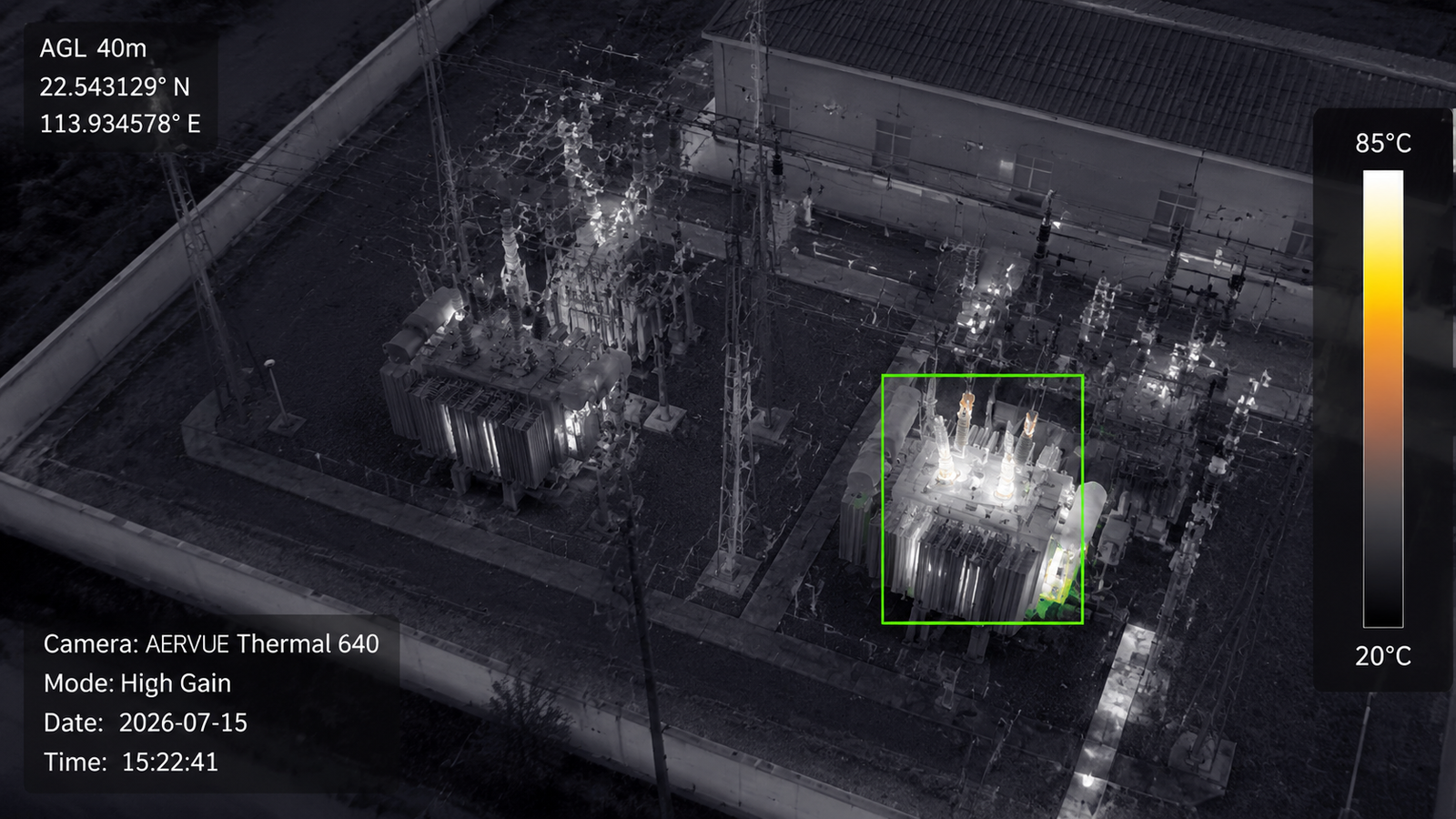
Application expansion. Five years ago the drone infrared camera use case was dominated by public safety and firefighting. In 2026, energy infrastructure inspection, precision agriculture, cold-chain monitoring, and building diagnostics have each grown into significant standalone segments — each with different resolution, radiometric, and integration needs.
Supply-side commoditization. Chinese sensor manufacturers have closed the resolution and NETD gap with US and European incumbents for most industrial-grade applications. This has expanded the OEM procurement pool, dropped unit prices at the 256, 384, and 640 resolution tiers, and made thermal integration economical on platforms that couldn't justify the cost in 2020.
2. Application Segments Driving the Infrared Camera for Drones Market
Seven application segments account for the bulk of the infrared camera for drones market in 2026. Each has distinct spec requirements and buying patterns.
| Segment | Typical resolution | Radiometric | Market share (est.) |
|---|---|---|---|
| Energy infrastructure inspection | 640 or 1280 | Required | ~24% |
| Precision agriculture | 384 or 640 | Required | ~18% |
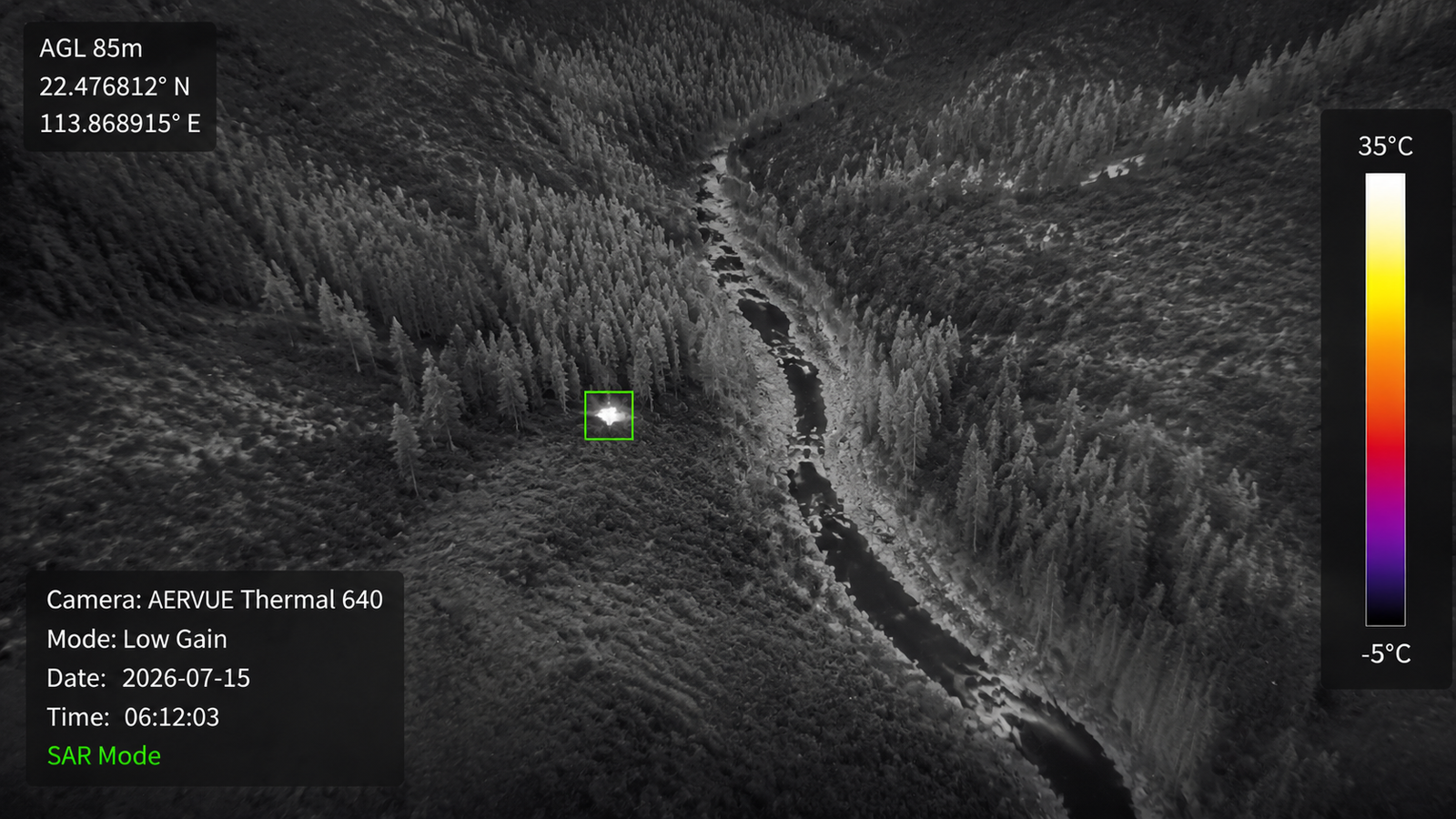
| Public safety and SAR | 384 or 640 | Optional | ~16% |
| Firefighting and wildfire monitoring | 640 | Required | ~12% |
| Building energy audits | 384 or 640 | Required | ~9% |
| Border and perimeter monitoring (civil) | 384 or 640 | Optional | ~8% |
| Research, mapping, other | Varies | Varies | ~13% |
Energy inspection is the largest and fastest-growing segment. A single 500 MW solar farm can require monthly thermal inspection to catch panel-level faults before they cascade. Multiply that across tens of thousands of installations globally, and the annual thermal inspection workload alone justifies significant OEM platform investment.
Public safety and search and rescue are lower-volume but high-visibility. A police department or fire service typically operates 2-8 thermal-equipped platforms, but the mission criticality drives premium-tier procurement decisions.
3. Sensor Technology: LWIR, MWIR, SWIR
Three infrared bands compete in the market, but for drone applications LWIR dominates for a straightforward reason: it does not require sensor cooling, which keeps modules under 200 grams and within reasonable power budgets.
LWIR (long-wave infrared, 8-14 microns). The dominant technology for drone thermal. Uncooled microbolometer arrays detect thermal radiation from ambient-temperature objects (people, vehicles, structures, animals) without needing active cooling. Modules are lightweight, power-efficient, and cost-effective at the volumes drone OEMs need. Standard NETD (noise-equivalent temperature difference) is 40-50 mK for consumer-tier and under 30 mK for professional-tier.
MWIR (mid-wave infrared, 3-5 microns). Superior contrast at high temperatures makes MWIR attractive for specialized applications like industrial furnace monitoring or long-range military-adjacent work. But MWIR sensors require cryogenic or thermoelectric cooling, which drives module weight to 500 g+, power draw to 20-40 W, and price to 5-10x LWIR at equivalent resolution. For the commercial drone market, MWIR is a niche.
SWIR (short-wave infrared, 1-3 microns). A specialized band useful for haze penetration, moisture and vegetation stress detection, and some material identification. Not a general thermal imaging technology. In the drone context, SWIR modules serve specific research and industrial use cases rather than the broad inspection market.
For 90%+ of the infrared camera for drones market, LWIR uncooled microbolometer sensors are the technology of choice. The remaining share is split between MWIR for specialized high-temperature applications and SWIR for niche research use cases.
4. Resolution Tiers in 2026
Four resolution tiers dominate the market. Each occupies a different price and application band.
| Resolution | Typical use case | Weight class | Price range (module, USD) |
|---|---|---|---|
| 256×192 | Entry-tier, lightweight platforms | 25-50 g | $120-180 |
| 384×288 | General inspection, mid-range detection | 50-90 g | $275-350 |
| 640×512 | Professional inspection, long-range detection | 90-160 g | $400-600 |
| 1280×1024 | High-end long-range identification | 200 g+ | $1,800-3,500 |
The sweet spot for OEM platform builders in 2026 is 384 and 640. The 384 tier offers strong price-performance for general inspection where the aircraft can fly close to the asset. The 640 tier is where professional-grade energy inspection, firefighting, and long-range SAR converge — enough detail for actionable diagnosis, still affordable enough for platform integration in the hundreds of units.
The 256 tier occupies the entry point where cost matters more than diagnostic detail — light platforms for basic thermal awareness rather than radiometric analysis. The 1280 tier is small in unit volume but growing in the specialized long-range identification and high-end research markets.
5. Radiometric vs Non-Radiometric
One of the most consequential procurement decisions is whether the module needs to be radiometric. This is not always the same as "does it need to measure temperature."
Radiometric modules record per-pixel temperature data with defined accuracy. Typical industrial-grade radiometric accuracy is ±2°C or ±2%. Higher-end modules reach ±0.5°C in specific temperature ranges, and medical-grade telethermographic devices reach ±0.2°C. Radiometric output enables quantitative analysis: energy audits, electrical fault classification, agriculture stress mapping, thermal signature comparison over time.
Non-radiometric modules display relative thermal patterns without absolute temperature calibration. They cost 30-50% less at equivalent resolution and are still useful for detection tasks where "hotter than surroundings" is the actionable signal — search and rescue, general situational awareness, coarse anomaly detection.
The buyer's mistake to avoid: assuming that "thermal camera" implies temperature measurement. It does not. If the application needs temperature values in the output — for reporting, for regulatory compliance, for repeat comparison — the module must be radiometric, and the accuracy specification must match the application's tolerance.
6. Output Interface Standards
Thermal modules for drone OEM integration ship with one of three output interfaces. The choice affects which flight controllers, ground stations, and processing pipelines can accept the data.
The trend since 2023 has been away from CVBS-only modules and toward USB and MIPI, driven by two forces: growth in software-defined ground stations that expect digital input, and growth in onboard AI processing that needs direct sensor access. Many OEM modules now ship with parallel CVBS and USB outputs to serve both legacy and modern integration paths.
7. Global Supplier Landscape in the Infrared Camera for Drones Market
The supplier landscape in 2026 splits into three tiers, each serving different OEM procurement profiles.
Tier 1: US and European incumbents. Teledyne FLIR, Seek Thermal, Workswell, and InfraTec hold the premium end of the market. Advantages: mature product lines, established ISO/quality certifications, deep application engineering support, and easier procurement paths for buyers in defense-adjacent markets where supply-chain vetting matters. Trade-offs: unit prices 2-4x Asian equivalents, longer lead times, and MOQs that can be prohibitive for small OEM platforms.
Tier 2: Chinese specialists. Guide Sensmart (Wuhan), iRay Technology, InfiRay, and Xi'an Optic-Electronic hold the mid-tier and are increasingly serving global OEMs. Advantages: strong resolution parity with Tier 1 at 256/384/640 tiers, competitive pricing, and MOQ flexibility. The past five years have closed most of the meaningful performance gap for industrial-grade applications. Trade-offs: quality control variability across suppliers, less mature English-language technical documentation, and export/compliance considerations that vary by destination market.
Tier 3: OEM integration specialists. Suppliers focused specifically on OEM drone integration — not on standalone module sales — have emerged as a distinct category. This tier typically sources sensor cores from Tier 2 manufacturers, adds integration engineering (mount, interface, cable harness, firmware), and serves OEM platform builders that want a productized module rather than raw components. This is where the fastest procurement paths exist for OEM platforms in the 100-1000 unit range.
8. OEM Procurement Considerations
For OEM platform builders sourcing thermal modules for a new build, six factors dominate the decision:
Resolution matched to detection range. A drone that needs to detect a person at 500 m needs 640 or higher. A drone doing close-in solar inspection at 20 m can operate on 256 or 384. Over-spec adds weight and cost; under-spec makes the platform less useful in its mission.
Radiometric requirement. Set by the application, not by preference. If the platform will do inspection or diagnostic work, radiometric is required. If it does surveillance or SAR, non-radiometric is often sufficient.
Weight and power envelope. A 25 g module fits a 3-inch inspection platform. A 160 g module needs a larger airframe. Power draw scales with resolution and frame rate — audit the platform's remaining power budget after propulsion and comms before locking in a resolution tier.
Output interface fit. CVBS for legacy analog integration, USB for radiometric output to software platforms, MIPI for direct-to-SoC embedded work. This has to match the flight controller and processing pipeline the platform runs.
MOQ and lead time. Sample tier typically 1-2 units. Starter tier 10-50. Production tier 100+. Volume tier 500+. Lead times range from days (samples) to weeks (production) to negotiated (volume/bulk). Match the tier ladder to the OEM's production ramp.
Supplier stability. ISO 9001 as a minimum for industrial-grade work. ISO 13485 for medical device supply chains. FDA 510(k) predicate history for regulated medical devices. Post-sales technical support for firmware updates and custom configurations. These become more important than unit price at production volume.
For platform teams working through the wider integration picture, our companion guides on AI vision development kits and multi-sensor module comparison cover the sample-to-production workflow and configuration decisions that sit alongside the sensor selection.
9. 2026-2028 Market Outlook
Three trends are likely to shape the infrared camera for drones market through 2028.
Onboard AI processing becomes standard. The share of thermal modules integrated with onboard AI inference — for automatic anomaly detection, target classification, and event logging — will grow from a small minority in 2024 to majority by 2028. This changes procurement: buyers will evaluate not just the sensor, but the combined sensor-plus-inference module. For a deeper look at this trend, see our companion guide on edge AI for drones.
Radiometric becomes the default. As inspection applications continue to dominate market growth, radiometric output moves from a premium option to the base configuration. Non-radiometric modules will remain in cost-sensitive surveillance and situational awareness applications but will lose share in the growth segments.
Supplier consolidation. The Tier 2/3 landscape will see consolidation as smaller Chinese suppliers merge or exit, and larger OEM integration specialists absorb custom-integration work. Buyers should factor supplier stability into 2027-2028 platform commitments — the module vendor you buy from in 2026 may look different by 2028.
Regulatory harmonization. BVLOS approval paths are converging across the FAA, EASA, and GCC frameworks toward common detect-and-avoid capability requirements. This will further expand the addressable market for thermal-equipped BVLOS platforms and drive spec convergence in the module segment.
10. Frequently Asked Questions
Industry analysts estimate the thermal imaging segment of the commercial drone camera market at approximately USD 800 million to 1.2 billion in 2026, with compound annual growth rates in the 12-18% range through 2030. Growth is driven by expanding inspection, agriculture, and public safety applications, plus regulatory progress on BVLOS operations that make longer thermal missions economically viable.
LWIR (long-wave infrared, 8-14 microns) is the dominant technology for drones because it detects thermal radiation from objects at ambient temperatures without cooling, keeping modules small and power-efficient. MWIR (mid-wave infrared, 3-5 microns) offers better contrast at high temperatures but requires cooled sensors, making modules heavier and more expensive. SWIR (short-wave infrared, 1-3 microns) is a specialized band used for haze penetration and moisture detection, not general thermal imaging.
Four resolution tiers dominate: 256×192 for lightweight and cost-sensitive applications, 384×288 for general-purpose inspection and mid-range detection, 640×512 for professional-grade inspection where detail matters, and 1280×1024 for high-end applications requiring long-range identification. Most OEM platforms select 384 or 640 as the sweet spot between price, weight, and detection performance.
It depends on the application. Radiometric modules record per-pixel temperature data with defined accuracy (typically ±2°C for industrial-grade or ±0.5°C for medical-grade), enabling quantitative analysis such as electrical fault detection, energy audits, and precision agriculture assessments. Non-radiometric modules only display relative thermal patterns and cost 30-50% less. Inspection and asset monitoring generally need radiometric; simple surveillance and situational awareness usually do not.
The supplier landscape has three tiers. US and European incumbents (Teledyne FLIR, Seek Thermal, Workswell, InfraTec) hold the premium end. Chinese specialists (Guide Sensmart, iRay, InfiRay, Xi'an Optic-Electronic) hold the mid-tier and are increasingly serving global OEMs. Emerging Asian suppliers focus on custom OEM integration and cost-optimized modules for high-volume drone platforms. Each tier fits different OEM procurement profiles.
Six factors dominate OEM sourcing decisions: sensor resolution matched to detection range requirements, radiometric versus non-radiometric based on application, weight and power envelope compatible with the airframe, output interface (CVBS analog, USB UVC digital, or MIPI) matched to the flight controller, minimum order quantity and lead time acceptable to the production ramp, and supplier stability including ISO certification and post-sales technical support.
Conclusion: A Maturing Market with Room to Choose
The infrared camera for drones market in 2026 is entering a mature growth phase. Sensor performance at the 256, 384, and 640 tiers has converged enough that most industrial-grade applications can be served by multiple supplier tiers. Regulatory unlock, application expansion, and supplier commoditization all favor OEM platform builders — the sourcing landscape is more open, competitive, and technically capable than at any point in the past decade.
The strategic question for platform builders is not "which sensor is best" but "which sensor fits my platform's mission profile, integration path, and production economics." Answer those three questions clearly, and the market offers real choice at every price tier.
AERVUE Technology supplies thermal modules across the 256, 384, and 640 resolution tiers with radiometric configurations, USB UVC and CVBS output options, and OEM integration support for drone platform builders in 40+ countries. If you are scoping a thermal module for a new build, our team can match a configuration to your platform, walk through the integration path, and ship a sample within 1 to 3 days.
Scoping a thermal camera for a drone OEM platform?
Tell us your platform, mission profile, and resolution target. We will recommend a configuration, walk through the integration path, and ship a sample within 1-3 days — with factory-direct pricing from sample to volume.