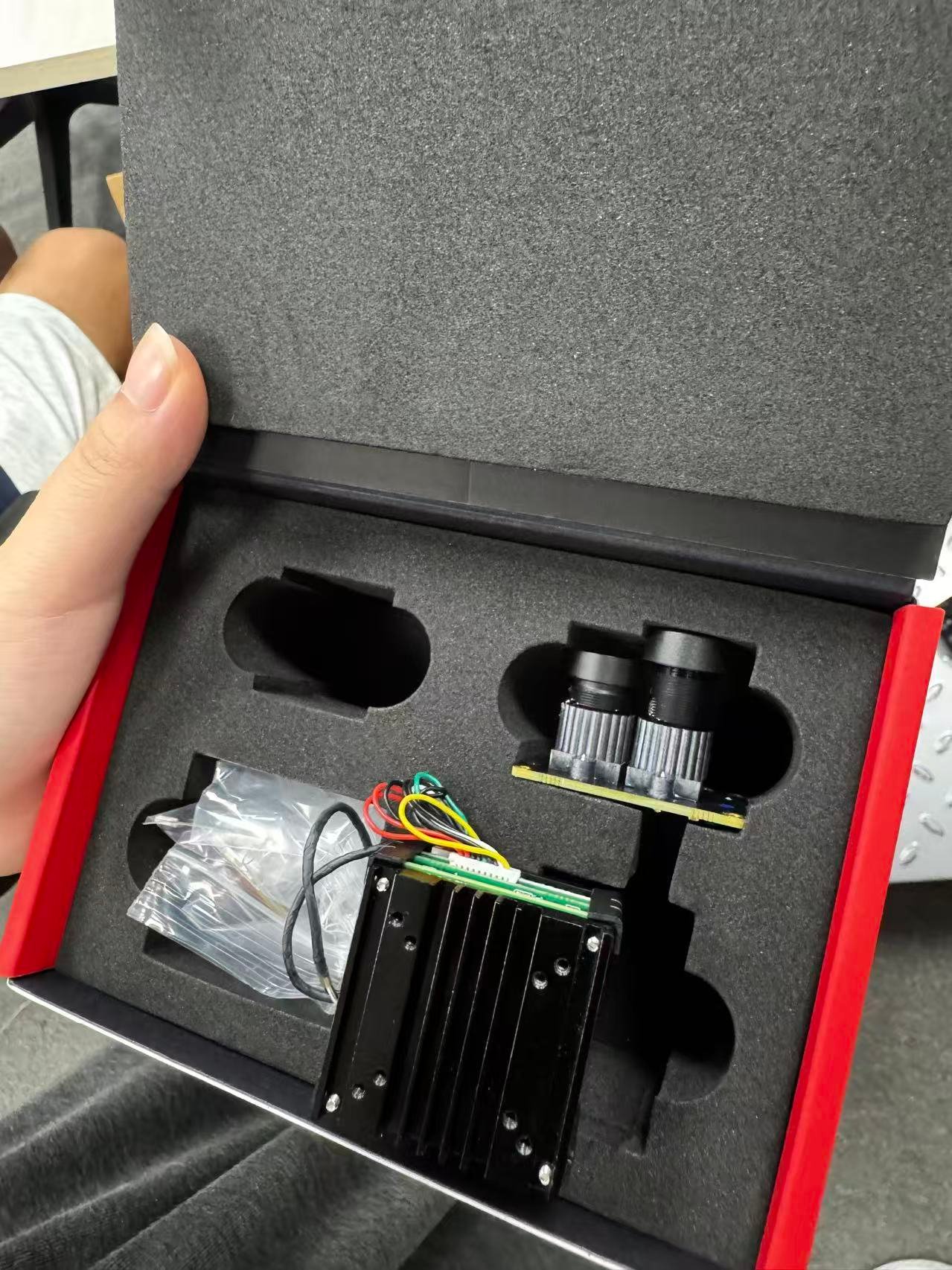
Edge AI for drones is the 2026 standard for commercial UAV platforms. It means running neural network inference directly on the airframe — detection, classification and tracking happen on a dedicated AI module, not on a ground GPU server. This guide covers 7 reasons onboard inference beats ground processing, how the pipeline actually works, and what to look for when sourcing an edge AI module for your drone platform.
1. What Edge AI for Drones Actually Means
"Edge AI" is a marketing term that gets stretched to cover anything from a smart light bulb to a self-driving car. For unmanned aerial vehicles the definition is narrower and more useful.
Edge AI for drones means three things together: a dedicated inference accelerator mounted on the airframe (an NPU or AI SoC, not the flight controller's MCU), a vision model running on that accelerator at real-time frame rates, and a telemetry path from the inference output to the flight controller so the drone can act on what it sees.
Strip out any of the three and you do not have edge AI. A drone that streams video to a ground laptop running YOLO is not running edge AI — that is ground processing dressed up. A drone with a powerful flight controller but no neural accelerator is not edge AI either — the FC can fly the airframe but it cannot run a 6 TOPS detection model alongside attitude control.
True edge AI for drones on a commercial UAV in 2026 looks like this: a 40 to 120 gram module mounted under or beside the gimbal, drawing 4 to 8 watts from the airframe power bus, running a quantized YOLO model on a dedicated NPU, outputting bounding boxes and target telemetry over CRSF or MAVLink to the flight controller at 30 to 60 Hz, with end-to-end latency under 50 milliseconds.
2. The 3 Failures of Ground Processing That Edge AI for Drones Solves
To understand why onboard AI inference won, look at what it replaced. The first generation of intelligent commercial drones — most platforms shipping between roughly 2018 and 2022 — used a ground processing architecture.
The drone carried a camera and a video transmitter. Everything intelligent happened on the ground: a laptop, an edge server, or a cloud instance ran object detection on the incoming video feed and sent commands back up to the drone. This architecture has three failure modes, and all three are operationally fatal for serious commercial work.
Failure 1 — Latency
A video frame captured on the drone has to travel through the camera ISP, the video encoder, the radio transmitter, the air gap, the ground receiver, the video decoder, and the inference engine before any detection comes out the other side. Best case on a tuned system is around 80 to 120 milliseconds. Real-world systems with weaker links run 200 to 400 ms.
For passive monitoring this is fine. For anything reactive — autonomous follow, target lock, collision avoidance, pixel-lock prosecution — half a second of round-trip lag is the difference between hitting and missing the target. A vehicle moving at 50 km/h travels 7 meters in 500 milliseconds. The drone is always shooting at where the target was, not where it is.
Failure 2 — Bandwidth and signal fragility
Ground processing demands a high-quality video stream from the drone every frame. That is exactly the data path that breaks first in real operating conditions. RF transmission at useful range is bandwidth-limited and prone to corruption from terrain, weather, distance and interference.
Edge AI for drones inverts this: the drone consumes its own raw, uncompressed sensor data at zero loss. The RF link only has to carry low-bandwidth telemetry — target ID, position, classification, confidence — which fits in a few hundred bytes per frame and degrades gracefully.
Failure 3 — Dependency on the link
Lose the link — through range, jamming, terrain, weather, or a contested electromagnetic environment — and a ground-processing drone is blind and stupid. It stops detecting, stops tracking, stops doing anything useful.
An edge AI drone keeps perceiving and deciding when the link drops. It can continue tracking a previously designated target, return to a known waypoint while still detecting threats along the way, or hand off to a different operator on link recovery.
3. Edge AI for Drones vs Ground Processing: Side-by-Side
- End-to-end perception latency under 50ms
- Operation continues if the RF link drops
- Detections run on raw sensor data, no compression artifacts
- Bandwidth requirement drops 100x (telemetry only)
- Multiple drones run from one ground station without saturation
- Closes the loop with the flight controller at frame rate
- Round-trip latency of 200–500ms — fatal for autonomy
- Drone becomes useless on link degradation
- Inference runs on lossy compressed video, more false positives
- Every drone needs a full video stream — bandwidth scales linearly
- Ground GPU must keep up with N drone feeds simultaneously
- Flight controller cannot react to perception, only operator input
This is not an academic comparison. For commercial drone OEMs in 2026, ground processing is a dead-end architecture. Skydio's X10 platform, Trillium's HD80-AIM gimbal, Teledyne FLIR's Prism SKR-equipped systems, and Chinese factory-direct modules including the AERVUE VisionCube series all converged on the same answer: onboard inference happening on the airframe.
4. The Edge AI for Drones Inference Pipeline
Every commercial-grade edge AI module on a drone in 2026 runs essentially the same four-stage pipeline. Knowing what each stage does is essential for picking the right module — bottlenecks at any stage cap the performance of the others.
The whole pipeline runs continuously, 30 to 60 times per second, with no external input. The flight controller can use the output to lock and follow a target, the gimbal can use it to keep the target centered, and the operator (when present) sees the same bounding boxes overlaid on the downlink — but the loop closes on the drone whether the operator is watching or not.
Two things to watch when comparing modules: tracker quality and post-processing depth. A cheap module runs YOLO and stops there. A serious module runs a real tracker on top, which is what gives you stable target IDs across hundreds of frames and graceful recovery from occlusion. The difference is invisible on the spec sheet and night-and-day in operations.
5. YOLO Models for Edge AI on Drones
YOLO ("You Only Look Once") is the dominant object detection architecture for commercial drone AI modules in 2026. Variants ship in commercial modules from AERVUE, Skydio, SIYI, Gremsy, and most Chinese factory-direct vendors. Knowing what version runs onboard and how it was prepared matters more than most buyers realize.
Model version
YOLOv7 is the most common production model on 2026 commercial drone AI modules — best ratio of accuracy to inference cost for the small-target, downward-looking drone-imagery problem. YOLOv8 variants are increasingly common at the higher end.
Newer is not always better here: YOLOv9 and v10 papers report improved mAP on academic benchmarks, but the gains often disappear when the model is quantized to INT8 and pruned for a 1 to 6 TOPS NPU.
Quantization
A YOLO model trained in FP32 floating point on a desktop GPU cannot run on a drone NPU at real-time frame rate. Every commercial module quantizes the model — usually to INT8 — which shrinks the model footprint by 4x.
Done well, INT8 quantization costs roughly 1 to 3 percentage points of mAP. Done poorly, it costs 10 or more. This is one of the most common reasons two modules with the same advertised TOPS perform completely differently in practice.
Pruning and compilation
Pruning removes redundant weights from the network. Compilation (TensorRT for NVIDIA, vendor-specific toolchains for Rockchip, Hailo, EdgeCortix) maps the network onto the specific instruction set and memory architecture of the target NPU. Together they typically give 2 to 4x throughput gains on top of quantization.
Buyer tip: When two AI modules quote the same TOPS, ask the vendor what model is shipping, what quantization scheme is used, and what their measured mAP retention is after optimization. A 6 TOPS module shipping a poorly quantized YOLOv8 with 35% mAP loss is operationally worse than a 1 TOPS module shipping a well-tuned YOLOv7 with 2% loss.
6. Onboard AI: TOPS, Latency and Frame Budget
TOPS (Tera Operations Per Second) is the headline spec of any edge AI module, and it gets misread constantly. TOPS is a measure of theoretical peak compute. It does not directly tell you frame rate, latency, or whether a given model will fit.
A rough rule: a 6 TOPS NPU runs a YOLOv7-small model on 1080p input at roughly 60Hz with 20 to 30 ms of inference latency. Add capture, preprocessing, postprocessing and the tracker, and total pipeline latency lands around 40 to 50 ms — the practical floor for closed-loop autonomous response on a drone.
A 1 TOPS module running the same model is a different operating point. To hit real-time you have to drop frame rate to 30Hz, reduce input resolution, or run a lighter model variant. For short-range, single-target, daytime applications it is the right cost to pay for the BOM saving and the lower SWaP.
7. Onboard AI Modules: Power, Thermal and SWaP
Power and weight constraints on small commercial drones are unforgiving. A 7-inch ISR airframe might have 200 to 400 grams of payload budget after the gimbal, battery and flight stack.
A 1 TOPS edge AI module typically lands at 40 to 70 grams and draws 3 to 5 watts. A 6 TOPS module is 80 to 120 grams and draws 5 to 9 watts. Those numbers seem small until you account for the thermal envelope.
Continuous inference at full TOPS produces continuous heat dissipation. Most commercial modules ship with a passive aluminum housing rated for ambient operation up to 50 to 70 °C, but in real flight the module sits in still air (or near-still air inside a fairing) and surface temperatures climb quickly under load.
A module that throttles thermally is a module that drops frame rate mid-mission — usually at the exact moment you need it most. Look for vendor data on sustained thermal performance, not peak.
Power supply quality matters as much as raw draw. Edge AI modules pull current in fast bursts — when the NPU spins up for a frame, peak draw can be 2 to 3x average. A drone power system that cannot supply those bursts cleanly will brown out the module under sustained load.
8. What Onboard AI Inference Unlocks Operationally
The capability list onboard AI enables on a commercial drone, compared to a ground-processing or no-AI baseline, is long. The highlights:
- Autonomous target follow. Drone locks a designated target and follows without operator input. The operator can drop the link, look away, or hand off to a different controller — the lock holds.
- Multi-target situational awareness. 50 simultaneous tracked targets is now standard on 6 TOPS modules. The flight controller and operator see a structured scene, not a video stream.
- Pixel-lock prosecution. Once a target is designated, the drone maintains visual lock at the pixel level — essential for FPV terminal guidance where the operator link is dropping. Teledyne FLIR's April 2026 Prism SKR announcement highlighted this as the operational differentiator for FPV missions.
- Sensor-fused detection. Modules with paired visible and thermal sensors run inference on both feeds, improving detection reliability across mixed lighting and obscurant conditions.
- RF-degraded operation. Drone continues perceiving and acting in contested or jammed environments. Telemetry-only downlink is far harder to jam than video.
- Swarm and fleet ground stations. Because each drone runs its own inference, one operator can supervise multiple drones without a ground server farm.
- OTA model upgrades. Hardware ships once; detection capabilities improve over the platform lifetime. New target classes deploy via firmware update without retrofitting modules.
9. What Onboard AI Cannot Do
Worth being clear about. Onboard AI inference is not magic and not all problems belong on the airframe.
Custom training requires factory involvement
Pre-trained models for vehicles and persons ship out of the box. Training new classes on the customer side is technically possible but rare — it requires labeled datasets in the tens of thousands of images, GPU training resources, and the vendor compiler toolchain. Most vendors handle custom training as a factory service at MOQ 100 or higher.
Deep semantic understanding is still ground-side
Edge AI on a 6 TOPS module runs object detection and tracking well. It does not run scene understanding, action recognition, or large multimodal models — those exceed available compute and memory. If your application needs the drone to understand intent, that processing happens off-airframe on a downlinked detection summary.
Edge AI does not replace a flight controller
The AI module is a perception system. The flight controller is the control system. A well-integrated drone has the AI module feeding the FC through a clean serial protocol with bounded data rates — not the AI module trying to fly the airframe directly.
10. Sourcing Edge AI for Drones: 8-Point Checklist
You have decided edge AI for drones is the right architecture. The next decision is which module to integrate. Walk through these 8 questions before placing an order on an onboard AI drone module:
- What model is shipping, and what is post-optimization mAP? YOLOv7 or v8 are fine; ask for measured accuracy retention after quantization.
- Measured end-to-end latency, capture to telemetry? Under 50ms is the floor for real-time autonomy.
- Sustained TOPS under thermal load, not peak? A module that throttles 30% after 5 minutes delivers 30% less than its spec sheet.
- What protocols does telemetry output support? CRSF for analog/racing-derived stacks, MAVLink for ArduPilot and PX4.
- OTA firmware update supported, and how? Locked-firmware modules are dead-end products.
- What is the OEM customization scope? Branded OSD, custom detection classes, custom housing.
- MOQ and lead time for your configuration? Factory MOQ is rarely the same as quoted MOQ.
- What documentation ships with the module? Pin assignment, protocol spec, mounting drawings, thermal and power profiles.
For a deeper breakdown of how spec tiers map to specific commercial UAV applications — defense ISR, search and rescue, agriculture, infrastructure inspection — see our companion guide on choosing the right drone AI tracking module. It covers the 1 TOPS vs 6 TOPS decision, mono vs dual visible vs thermal-hybrid sensor configurations, and use-case-by-use-case recommendations.
11. Frequently Asked Questions
Edge AI for drones means running neural network inference directly on the airframe — object detection, classification and tracking happen on a dedicated AI module mounted on the drone, not on a ground station or cloud server. The drone sees, decides and acts without round-trip latency or external bandwidth.
For onboard drone AI inference, 1 TOPS handles a single 1080p camera at 30Hz with a moderate-depth YOLO model — enough for short-range single-target tracking. 6 TOPS handles dual cameras at up to 60Hz with deeper models and multi-target tracking — required for ranges beyond 500m or busy scenes.
Three reasons: latency (every 100ms of round-trip delay degrades tracking and is unacceptable for autonomous response), bandwidth (high-quality video is fragile over long-range RF and is the first thing to drop in contested environments), and dependency (a drone that needs a live link to think cannot operate when the link fails). Edge AI for drones closes all three gaps by moving inference onto the airframe.
YOLOv7 and YOLOv8 variants are the 2026 standard for onboard drone AI inference. The exact version matters less than the post-training optimization — pruning, INT8 quantization, and TensorRT or vendor-specific compilation are what get a 6 TOPS NPU to run a 1080p model at 60Hz with under 50ms latency.
Edge AI for drones gives the platform perception and decision-making independent of the operator link. Visual navigation, target re-acquisition after signal loss, and pixel-lock prosecution of a designated target are all possible without GPS or active RF telemetry — provided the AI module has enough TOPS to run vision-based localization alongside detection.
Yes — and it is now the standard for 24-hour operations. Modules like the AERVUE VisionCube DT and DT Pro pair a visible CMOS sensor with a 384×288 or 640×512 uncooled LWIR thermal core, and run inference on both feeds simultaneously. Thermal fusion improves detection reliability in fog, smoke and total darkness — operating conditions where visible-only modules fail.
Pre-trained classes for vehicles and persons ship out of the box on most edge AI drone modules. Custom training (specific vehicle types, vessel categories, drones) is typically available as a factory service at MOQ 100 or higher, since it requires labeled datasets, GPU training resources, and the vendor compiler toolchain to deploy.
Conclusion: Edge AI for Drones is the Default in 2026
The transition from ground processing to edge AI for drones is the most important architectural shift in commercial drone development in the last decade. It is also already complete at the platform level — every serious commercial UAV manufacturer in 2026 has converged on the same answer. The drone perceives and decides on the airframe. The ground station supervises.
For OEM platform builders, the practical implication is simple: integrate an onboard AI module from day one, not as a retrofit. The cost premium over a no-AI baseline is small relative to the total platform BOM, the capability uplift is enormous, and the deployment economics improve dramatically once a single operator can supervise multiple drones without saturating a ground GPU.
The remaining question — which module — comes down to TOPS tier, sensor configuration, and supplier integration support. The AERVUE VisionCube range covers the 1 TOPS to 6 TOPS spectrum with mono, dual visible, and thermal-hybrid configurations, ships with documented protocols and OTA support, and is factory-priced for OEM integration.
Evaluating onboard AI modules for your drone platform?
Tell us your airframe, mission profile, and detection range requirements. We will recommend the right VisionCube tier and sensor configuration — factory-direct pricing, OEM customization, and sample availability within 1–3 days.