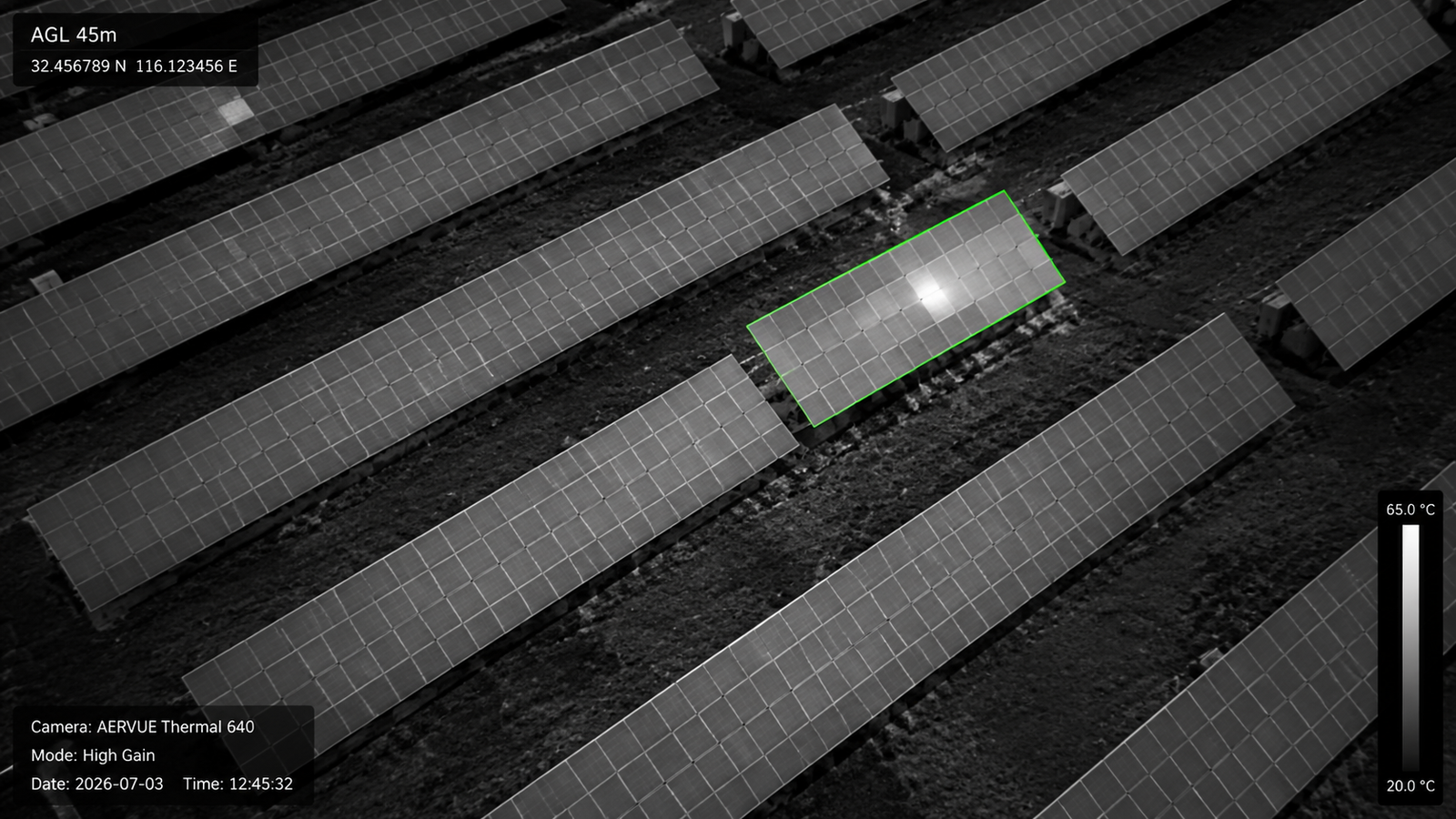
AI vision for BVLOS drones is not the same problem as AI vision for line-of-sight platforms. When the aircraft flies beyond the operator's visual line of sight, the whole architecture assumption changes — you cannot rely on the ground link for time-critical decisions. This guide covers what BVLOS actually demands from an onboard vision pipeline, why ground-processing architectures break at range, and 6 concrete criteria OEM platform builders should apply when choosing an AI vision module for a BVLOS platform.
1. What BVLOS Means for AI Vision Architecture
BVLOS — Beyond Visual Line of Sight — is not primarily a distance term. It's a regulatory and operational category defining flight where the pilot in command cannot see the aircraft directly. Practically, BVLOS operations run anywhere from a few hundred meters (past a hill or building line) to tens of kilometers on long-range inspection missions.
What matters for AI vision for BVLOS drones is not the distance itself. It is what the distance changes about the communication link between aircraft and operator. In line-of-sight flight, an operator can watch the aircraft, correct a problem in real time, and use a ground computer to process the video feed. In BVLOS flight, none of those assumptions hold reliably.
Radio bandwidth to the aircraft becomes intermittent. Latency stops being predictable. Video quality degrades. And critically, decisions that used to be made by an operator watching a screen now have to be made by the aircraft itself — because by the time a detection result reaches the ground and a corrective command comes back, the aircraft has already moved 30 to 100 meters through the scene.
2. Why Ground Processing Breaks at BVLOS Distance
The most common architecture for early drone AI was: stream 1080p video down to a ground station, run detection on a GPU, send results back. This works well within 1 to 2 kilometers of the operator. It breaks at BVLOS distance for three compounding reasons.
Bandwidth collapse. Radio link bandwidth drops as an inverse function of range and interference. A link that supports 8 Mbps at 500 meters may fall to 500 kbps at 5 kilometers, and drop below 100 kbps behind terrain. High-resolution video is the first thing to go — and once video quality degrades, so does the detection accuracy of any ground-side model.
Latency uncertainty. A round-trip through a degraded link can drift from a stable 80 ms to a spiky 400-1200 ms with occasional multi-second stalls. For any tracking, obstacle avoidance, or automatic asset detection task, this latency variance is fatal. A tracker that runs at variable frame rates loses lock. A collision-avoidance system that gets a warning 800 ms late is not a collision-avoidance system.
Link loss. BVLOS operations must be safe with intermittent or lost ground links. If the aircraft's ability to see and understand its environment depends on the link, then link loss means the aircraft is blind. Any BVLOS-certified operational approval requires that the aircraft continue to fly safely without ground processing.
3. The 4 Constraints BVLOS Imposes on Onboard Vision
Once ground processing is off the table, the constraints on the onboard vision pipeline sharpen considerably. Four constraints tend to drive design decisions:
Constraint 1: Time-to-decision must be sub-100 ms. For a BVLOS aircraft moving at 15-25 m/s, every 100 ms of processing latency represents 1.5-2.5 meters of positional drift between the frame captured and the decision made. Onboard inference at 25-60 Hz keeps this drift within the tolerance most missions can absorb.
Constraint 2: Power budget is fixed. The vision module competes for the same battery or fuel-cell energy as the propulsion system. A module that draws 15 W on a small quadcopter is meaningfully impacting endurance. A well-designed BVLOS vision pipeline should target 4-10 W typical draw with 12-18 W peaks during inference bursts.
Constraint 3: Weight budget is fixed. BVLOS platforms are typically weight-critical because endurance scales inversely with mass. A 44 g mono-visible module is a very different platform impact from a 120 g visible-plus-thermal module. Both can be right depending on mission — but the weight decision has to be made upfront.
Constraint 4: The module must survive the flight envelope. BVLOS flight covers real weather, real vibration, real thermal shocks. A module designed for bench testing at 25 °C will not perform reliably at 65 °C after 40 minutes of direct sun on the airframe.
4. Onboard AI as the Only Viable Architecture
Given the four constraints above, onboard AI is not one option among several. It is the only architecture that closes the loop with acceptable performance across the BVLOS operating envelope. A well-designed onboard AI vision for BVLOS drones pipeline runs the detection model, the tracker, and the output telemetry entirely on the airframe, and only streams high-level structured data (target ID, position, velocity, class, confidence) down the link.
This has three practical benefits that matter more than raw performance:
- Bandwidth economy. Sending 200 bytes of telemetry per detection instead of 8 Mbps of video reduces bandwidth requirements by five orders of magnitude. The aircraft can operate on degraded links that would kill a video-streaming architecture.
- Latency determinism. Inference latency on the aircraft is predictable — driven by the model size and NPU throughput, not the radio link. This is what allows tight closed-loop tracking under motion.
- Graceful link-loss behavior. If the link drops, the aircraft continues to see and understand its environment. The operator loses situational awareness, but the aircraft doesn't lose flight-critical capability.
The trade-off is that the aircraft carries the compute, the model, and the sensor stack itself. That is what makes module selection the central decision for a BVLOS platform. For a broader look at how onboard AI compares against ground-processing architectures across use cases, see our companion guide on edge AI for drones.
5. Long-Endurance and Hydrogen Platforms
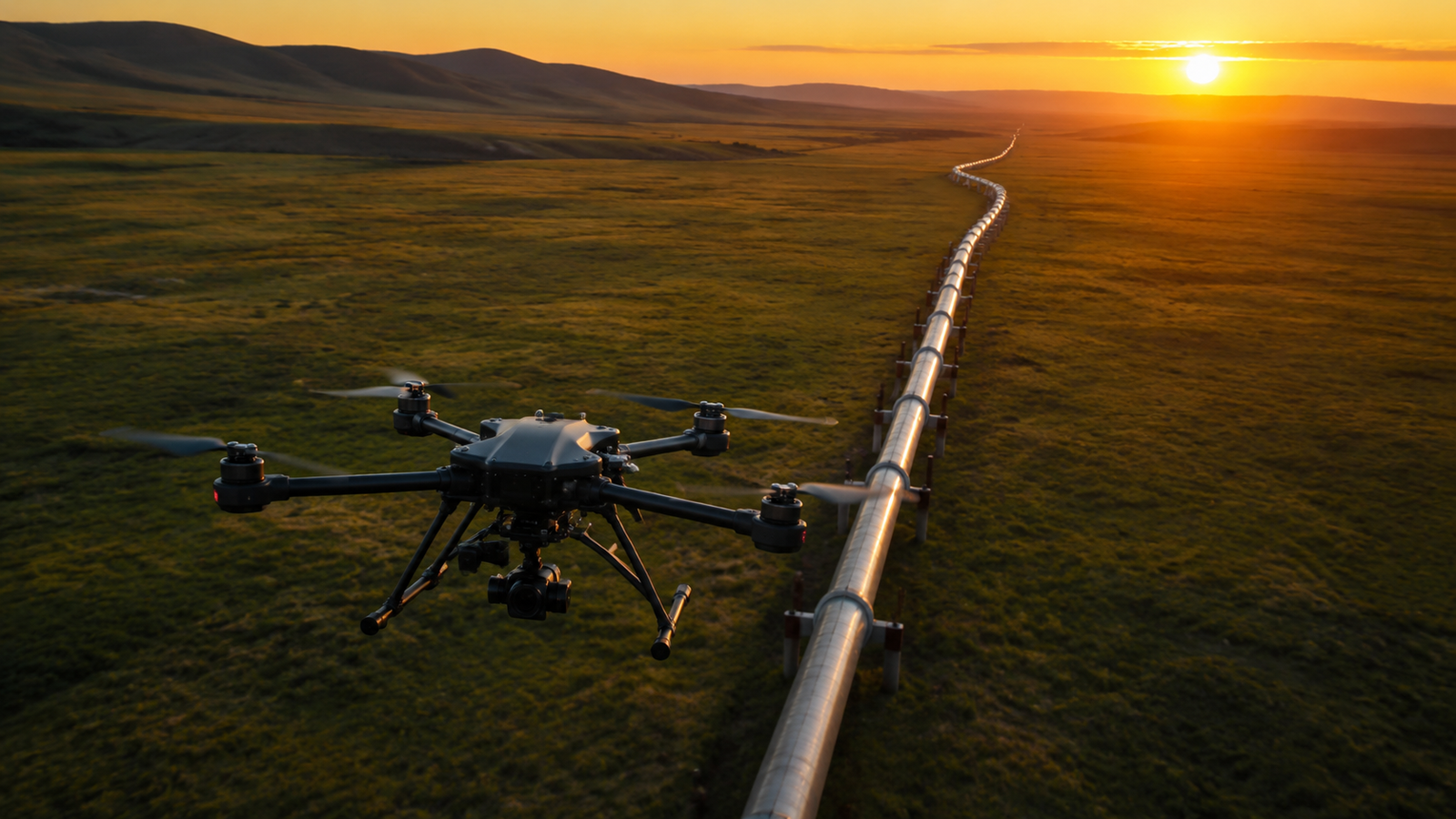
Long-endurance platforms — hydrogen fuel cells, hybrid gas-electric, high-density battery configurations — are where AI vision for BVLOS drones matters most, because these platforms are built specifically for missions that require sustained flight beyond visual range.
A typical hydrogen multi-rotor delivers 90-180 minutes of flight time, which is 3 to 5 times a comparable battery platform. That endurance is what makes long-range pipeline patrol, wind farm inspection, and remote asset monitoring economically viable. But the endurance also multiplies the AI vision workload: instead of processing 20 minutes of video, the onboard module needs to run continuously for 2-3 hours on the same power budget.
This changes the module selection math. Power efficiency becomes as important as raw TOPS. Thermal management under sustained inference matters more. And the module must maintain performance across a wider thermal drift — because a two-hour flight can span multiple weather conditions and sun-angle changes.
Long-endurance BVLOS missions typically demand:
- Continuous inference at 25-30 Hz for 2+ hours without thermal throttling
- Sensor configuration matched to mission duration — visible-plus-thermal for day/night coverage, mono-visible for daytime-only
- Power draw that fits within the platform's remaining budget after propulsion and comms
- Structured telemetry output that can be logged onboard for post-flight review
6. Tethered and Persistent Platforms
Tethered drones — platforms connected to a ground power source via a fiber-optic and power tether — occupy a different corner of the BVLOS envelope. They are stationary in position but persistent in time, sometimes airborne for 12-24 hours continuously. The vision workload is different: continuous surveillance of a fixed scene, often with multi-target tracking as objects enter and leave the field of view.
For tethered platforms, the constraints invert somewhat. Power is less scarce (fed from the ground) and weight is somewhat less critical (the tether carries some load). But thermal management becomes the dominant constraint, because the module runs continuously for many hours in whatever ambient conditions the deployment presents.
A tethered platform running an onboard AI module for 18 hours needs:
- A thermal design that dissipates sustained inference heat without degradation
- Detection continuity across long time-of-day changes (morning-to-evening lighting variation)
- Robust multi-target ID tracking as targets enter and leave the field of view repeatedly
- Structured event logging that reduces multi-hour video into a manageable event stream
7. 6 Criteria for Choosing AI Vision for BVLOS Drones
Given all of the above, six practical criteria matter when a platform builder selects an AI vision for BVLOS drones module for a specific platform:
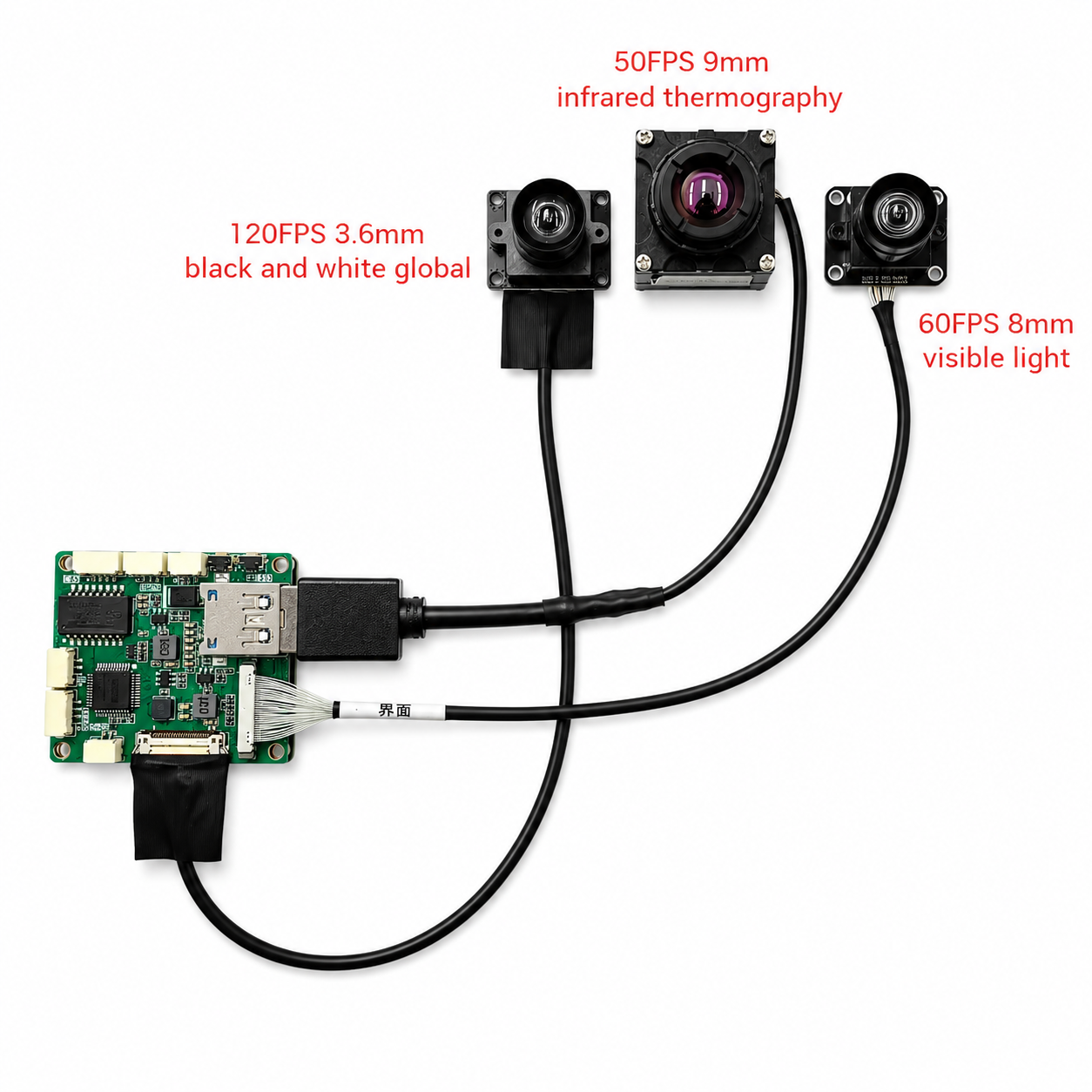
The AERVUE AI VisionCube family, for example, ranges from 1 TOPS mono-visible S at 44 g through 6 TOPS visible-plus-thermal DT Pro configurations, letting the same platform team match a module to different mission profiles without changing integration architecture. For a complete side-by-side of the range, see our AI VisionCube comparison guide.
8. Integration Considerations at BVLOS Range
Once the module is chosen, integration into a BVLOS platform runs into some specific patterns worth flagging in advance. The good news is that most modern OEM autopilots (Pixhawk-class, CUAV, KDS, similar) already accept the standard AI vision telemetry protocols. The integration is usually a wiring, mounting, and firmware exercise rather than a re-architecture.
Telemetry protocol. CRSF and MAVLink are the two dominant formats. CRSF is the compact choice for FPV-derived platforms and small OEM UAVs. MAVLink is the standard for Pixhawk, ArduPilot, and PX4 platforms, and is documented in the MAVLink Common Message Set. Most AI vision modules support both.
Mounting. BVLOS platforms typically fly farther and encounter more dynamic conditions than short-range platforms. Vibration damping matters more, thermal isolation matters more, and lens protection matters more. A vision module that shifts 0.5 mm under vibration will introduce tracking errors that get worse at range.
Power feed. The vision module's power feed should be conditioned to survive the voltage swings of a real airframe — not pulled directly off the main bus without buffering. A brownout that resets the module mid-mission is a mission failure.
Data logging. BVLOS missions generate valuable operational data. A well-integrated vision pipeline logs structured events onboard (target detections, tracking events, confidence drops) alongside the flight controller's log, so post-flight review can correlate detection events against flight conditions.
9. Regulatory Landscape for BVLOS in 2026
Regulation is finally catching up to the technical maturity of BVLOS operations, though at different rates in different jurisdictions. Three frameworks matter most for platform builders in 2026:
| Region | Framework | Status | Key requirement |
|---|---|---|---|
| United States | FAA Part 108 | Progressing toward routine BVLOS | Demonstrable detect-and-avoid |
| European Union | EASA U-space + SORA | Operational, category-based | Air-risk and ground-risk assessment |
| United Kingdom | CAA BVLOS pathway | Trial corridors expanding | Approved detect-and-avoid solution |
| Saudi Arabia | GACA UAS regulations | Category-based approval | Approved operator + capable platform |
| UAE | GCAA CAR-UAS | Operational | Zone-specific approvals |
| Australia | CASA BVLOS approval | Established | Operator training + platform capability |
The common thread across all these frameworks is detect-and-avoid — the requirement that the aircraft can identify and respond to potential conflicts without a human operator watching. This is where onboard AI vision plays a central role, and it is why regulators increasingly view robust onboard perception as a prerequisite for BVLOS approvals rather than an optional feature.
For platform builders scoping a BVLOS product, the practical implication is that the AI vision module choice is not just a performance decision but a regulatory-path decision. A module that can demonstrate consistent detection performance across the operating envelope makes the certification story easier. A module that performs inconsistently makes it very hard.
10. Frequently Asked Questions
AI vision for BVLOS drones refers to onboard computer vision systems that perform detection, tracking, and inference directly on the aircraft while it operates beyond the operator's visual line of sight. Because BVLOS missions cannot depend on continuous ground-link bandwidth or low-latency round-trips to a ground station, the vision pipeline must complete inference locally on the airframe.
At BVLOS ranges, radio-link bandwidth drops, latency rises, and packet loss becomes unpredictable. A vision pipeline that depends on streaming full-resolution video to the ground and receiving detection results back can experience 300 ms to multi-second delays — unacceptable for tracking, obstacle awareness, or automatic asset detection. Onboard inference removes the ground-link from the loop for time-critical decisions.
For typical BVLOS applications — asset inspection, target tracking, obstacle awareness — a quantized YOLO-class model running at 25-60 Hz needs 1-6 TOPS of dedicated inference. Modules in this range are 40-120 grams, draw 4-15 W, and can hold detection continuity across the flight envelope without a companion computer.
It depends on mission profile. Daytime asset inspection over agriculture or solar farms often needs only visible imaging with 1 TOPS. Long-range pipeline patrols or utility inspection with 24-hour coverage typically require a visible-plus-thermal configuration with 6 TOPS to sustain detection through varying light and weather. Long-range multi-target ISR-class inspection can benefit from a triple-sensor configuration.
In the US, FAA Part 108 is progressing as the framework for routine BVLOS operations. In the EU, EASA's U-space regulation and SORA methodology govern BVLOS approvals. In the GCC, GACA (Saudi Arabia) and GCAA (UAE) have their own BVLOS approval processes tied to specific operational categories. All three frameworks require demonstrable detect-and-avoid capability, which is where onboard AI vision plays a central role.
Yes, if the platform can accommodate the module's weight, power, and interface requirements. Most modern OEM drones running Pixhawk, CUAV, or similar autopilots accept CRSF or MAVLink telemetry inputs, which is how onboard AI vision modules stream detection results to the flight controller. The upgrade path is usually a wiring and firmware exercise rather than a re-architecture.
Conclusion: BVLOS Rewards Well-Chosen Onboard Vision
The transition from line-of-sight to BVLOS operations rewards platform builders who choose AI vision for BVLOS drones deliberately. The wrong module — undersized on compute, oversized on power, poorly matched on sensors — creates operational failures that only appear at range, when the aircraft is farthest from help. The right module makes the certification story easier, the mission economics work, and the platform capable of the mission profiles that justify a BVLOS platform in the first place.
The framework is simple: match TOPS to mission compute demand, match sensors to lighting and mission duration, match power and weight to the platform, and match integration path to the existing autopilot. Get those four decisions right, and BVLOS becomes a design choice rather than an operational risk.
For platform teams scoping AI vision modules for a new BVLOS build, or upgrading an existing platform for extended range operations, our team can walk through the trade-offs against your specific mission profile, recommend a configuration, and ship a development kit within 1 to 3 days. Companion guides on edge AI for drones and AI vision development kits cover the architecture and evaluation workflow that sit alongside this selection process.
Scoping AI vision for a BVLOS drone platform?
Tell us your platform, mission profile, and endurance target. We will match a configuration, walk through the integration path, and ship a sample within 1-3 days — with factory-direct pricing from sample to volume.