A drone AI tracking module is the smallest box on a modern UAV that does the most operational work. It identifies vehicles, persons, and other targets in real time, follows them across frames, and reports their position to the flight controller — all without ground processing or an internet link. This guide covers what to look for when sourcing one for an OEM platform.
1. Why Onboard Drone AI Matters Now
The first generation of commercial drones offloaded all intelligence to the operator. The drone flew, the operator watched the feed, and any decision about what to track or follow happened on the ground. That works for basic operations. It breaks down for autonomous platforms, for missions where the operator cannot watch the screen continuously, and for any deployment where bandwidth back to the operator is limited or contested.
An onboard drone AI tracking module closes that loop at the airframe. The drone sees a target, classifies it, and follows it without operator input. For commercial OEM platforms in defense, agriculture, infrastructure, and search-and-rescue, this changes both capability and unit economics. AI tracking that previously required ground GPU servers now runs on a 60-gram module mounted to the drone underside, using 4 to 8 watts.
The result: a category of drone capability that used to cost thousands of dollars per platform now costs a few hundred. The 2026 question for an OEM platform builder is not whether to integrate AI tracking. It is which module to integrate.
2. How a Drone AI Tracking Module Works
Every drone AI tracking module in this category performs the same four-step pipeline:
- Capture. One or more cameras (visible, dual visible, or visible plus thermal) feed video into the module's SoC.
- Inference. A neural network — typically YOLOv7 or a YOLOv8 variant in 2026 — runs object detection on each frame. Output: bounding boxes with class labels (vehicle, person, vessel, drone) and a confidence score.
- Tracking. A tracking algorithm associates detections across frames so a target seen at frame 1 is the same target ID at frame 100, even after partial occlusion or scale change.
- Output. The module sends telemetry over CRSF or MAVLink: target ID, position in frame, velocity, classification, and confidence. The flight controller uses that to lock on, follow, or relay to the ground.
The TOPS rating (Tera Operations Per Second) is what makes this real-time. A 1 TOPS module runs inference on a single 1080p camera at 30Hz with a moderate-depth model. A 6 TOPS module runs two cameras simultaneously at 60Hz with a deeper model, plus tracking and post-processing — all at the airframe with zero ground latency.
The model itself is pre-trained at the factory on commercial-relevant classes: vehicles, persons, marine vessels. Some vendors offer custom training programs at higher MOQs for specialized targets.
3. The Four Specs That Actually Matter
A drone AI tracking module spec sheet can run to thirty parameters. For platform integration decisions, four matter:
| Spec | What it tells you | Why it drives the decision |
|---|---|---|
| TOPS rating | Compute capacity for neural inference | Sets how many cameras, what model depth, and what frame rate are realistic |
| Sensor configuration | Mono visible, dual visible, or visible + thermal | Defines detection range, day/night capability, and redundancy |
| Detection range | Vehicle and person ranges in meters | Maps directly to mission profile — short-range patrol vs long-range ISR |
| Target capacity | Number of simultaneous tracked targets | Determines whether the module supports multi-target prosecution or single-target lock |
The other specs — frame rate, voltage range, weight, latency — all matter for integration but rarely decide between two modules at the same TOPS tier. Two 6 TOPS modules from different vendors will perform similarly on inference; what differs is sensor pairing, detection range, and OEM support.
4. 1 TOPS vs 6 TOPS: When Each Makes Sense
The compute split between 1 TOPS and 6 TOPS modules is not "good vs better." They serve different mission profiles and different airframe classes. The question is not which is more capable — it is which fits your platform.
- Detection range up to ~450m for vehicles, ~170m for persons
- Single visible or visible + thermal pairing
- Lower BOM cost — sub-300 USD module
- Lighter airframes — sub-200g platforms
- Daytime or simple low-light operations
- Single-target lock or simple multi-target detection
- Detection range up to ~1.2km for vehicles, ~500m for persons
- Dual visible camera with wide + telephoto pairing
- 60Hz inference for fast-moving target tracking
- Multiple simultaneous targets in a complex scene
- Headroom for deeper models and post-deployment OTA upgrades
- Mid-to-large airframes with 200g+ payload budget
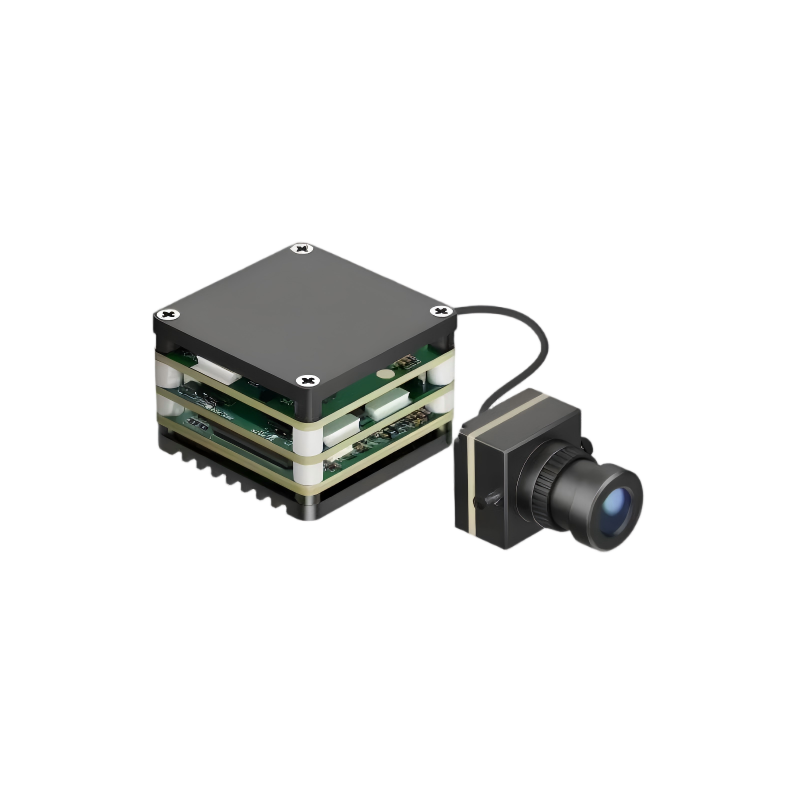
The AERVUE VisionCube S sits at the 1 TOPS tier with a single visible 4mm lens. VisionCube D sits at 6 TOPS with dual visible (3.9mm + 12mm). For most commercial OEM platforms, the cost difference between the two is small relative to the total drone BOM — but the capability difference is significant. If your platform operates beyond 500m or expects to track multiple targets in a busy scene, 6 TOPS is the practical floor.
5. Mono, Dual, or Hybrid: Choosing the Camera Configuration
Three configurations dominate the drone AI tracking module market:
Single visible camera
One CMOS sensor, typically 1080p at 30Hz. Sufficient for most daytime operations. Detection range is shorter than dual-camera modules because the model has only one viewpoint. The right choice for cost-sensitive platforms and applications where ambient light is reliable — agriculture, infrastructure inspection in daylight, light surveillance.
Dual visible camera
Two sensors paired short-focal and long-focal. AERVUE VisionCube D uses 3.9mm + 12mm — wide for situational awareness, narrow for detail at distance. Detection ranges roughly double over single-camera modules at the same TOPS tier. Cost premium is moderate. The default choice for any platform that operates beyond a few hundred meters in daylight.
Visible + thermal hybrid
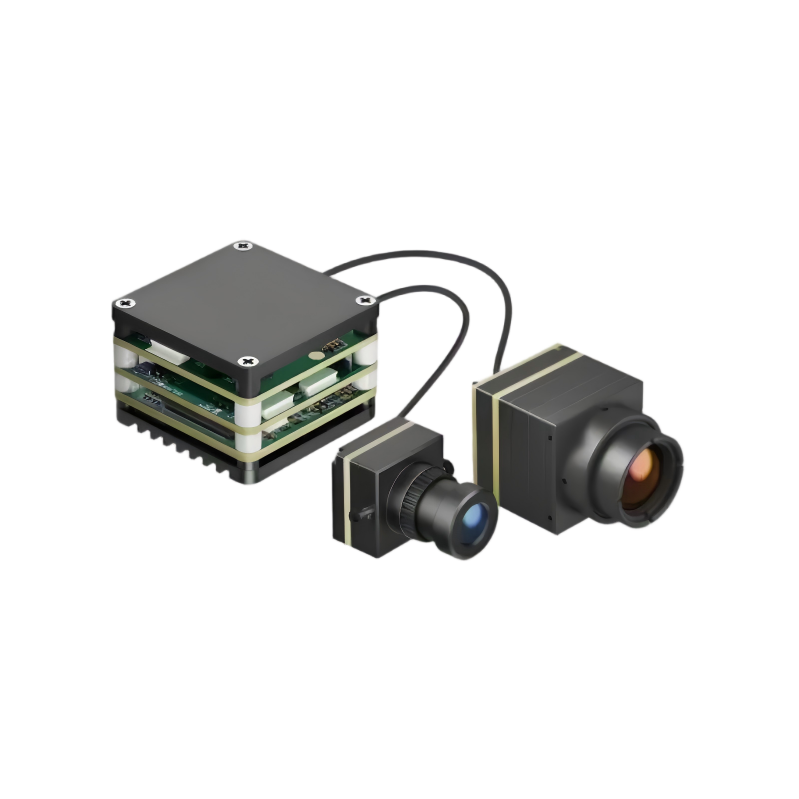
One CMOS visible sensor paired with an uncooled thermal core (384×288 or 640×512). This is the configuration for 24-hour operations. Thermal carries through smoke, fog, and total darkness; visible provides color and detail. The AI model can fuse both feeds, which improves detection reliability across a wider range of conditions. Cost is higher but the operating envelope expands dramatically.
The decision between these three is mostly about the operating envelope, not raw performance. A drone that flies only in daylight does not need thermal. A drone that flies at dusk, dawn, in industrial environments with smoke or steam, or at night, needs thermal pairing — single visible is not enough.
6. When You Need Thermal: 24/7 Operations
Thermal sensors detect emitted infrared radiation rather than reflected visible light. They work in conditions where any visible camera fails: total darkness, dense fog, smoke from fires, dust storms, even through some lightweight camouflage. For commercial drone applications where missing the target is not acceptable — search and rescue, fire and HAZMAT response, infrastructure security, defense ISR — a thermal-paired AI module is operationally required, not optional.
Thermal resolution matters. A 384×288 core (used in VisionCube ST and DT) detects vehicles and persons at standard surveillance ranges. A 640×512 core (used in ST Pro and DT Pro) has 2.7x more pixels per frame, which translates directly into longer detection range and higher classification confidence at the edge of range. For platforms operating beyond 1km, the 640 core is the difference between confirming a target and guessing.
Frame rate also matters more than buyers expect. 25Hz versus 50Hz thermal is the difference between smooth tracking of a moving target and seeing it as a series of jumps. The DT Pro and ST Pro modules run thermal at 50Hz natively, which is important when the target is moving — vehicles, persons in pursuit, vessels at speed. Lower-rate thermal modules (25Hz) handle stationary or slow-moving targets fine but lose lock on fast targets near the range limit.
7. Integration in Practice: Protocol, Weight, Power
Specs do not matter if the module does not integrate cleanly with your flight stack. Three integration concerns dominate:
Protocol compatibility
The module must speak CRSF (Crossfire / ELRS) or MAVLink. CRSF is standard for analog FPV ecosystems and most racing-derived platforms. MAVLink is the standard for ArduPilot and PX4 autonomous stacks. The AERVUE VisionCube range supports CRSF natively and offers a MAVLink option on D, DT, and DT Pro. Verify your flight controller's protocol before ordering — a mismatch is solvable with a serial bridge but adds 30+ grams and integration time.
Weight and form factor
A 7-inch ISR airframe has roughly 200–400g of payload budget. A drone AI tracking module typically takes 60–120g, which is non-trivial. Form factor matters too — most modules ship as a sealed cube with M3 mounting and a 6-pin connector, but vibration damping and EMI shielding requirements vary. Check the connector pinout against your flight stack early; a non-standard pinout costs a day or more to adapt.
Power
Most modules run on 9–16V — 3S to 4S battery direct or via a bus regulator. Power draw is 4–8W under full inference. Your drone power system needs to supply this without dropouts. Brown-out under sustained inference load is the most common integration failure mode for cheap modules; a dedicated voltage regulator on the airframe usually solves it.
Beyond protocol, weight, and power, firmware path matters for long-term deployment. Modules with locked firmware are dead-end products. Modules with documented OTA upgrade paths let you ship v1 today and deploy updated detection models a year later without retrofitting hardware. AERVUE supports OTA on D, DT, and DT Pro.
8. Use Case Scenario Guide
The right tier in the drone AI tracking module range depends on what your platform is doing. Here is a breakdown by commercial use case:
9. AERVUE VisionCube Range
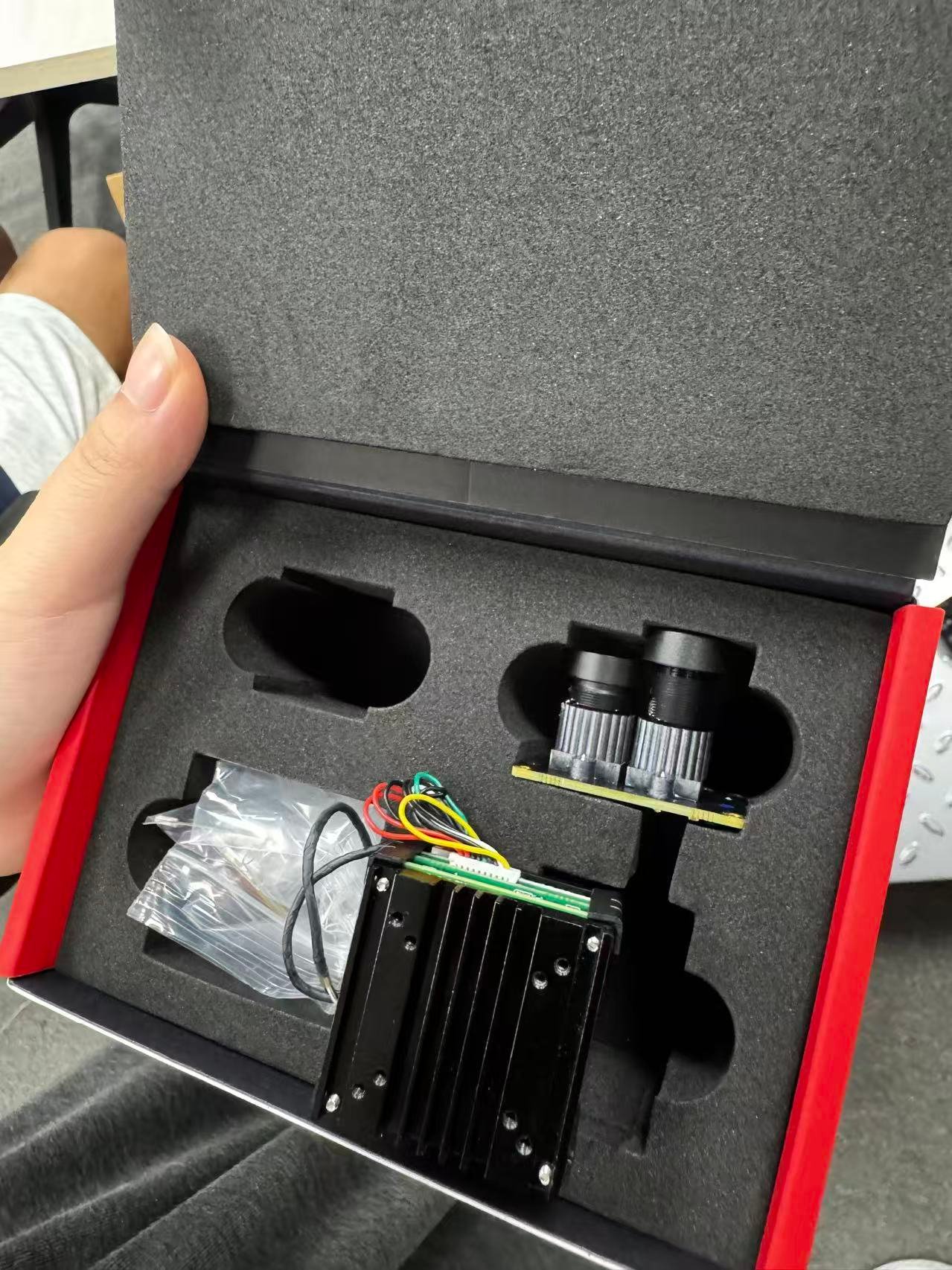
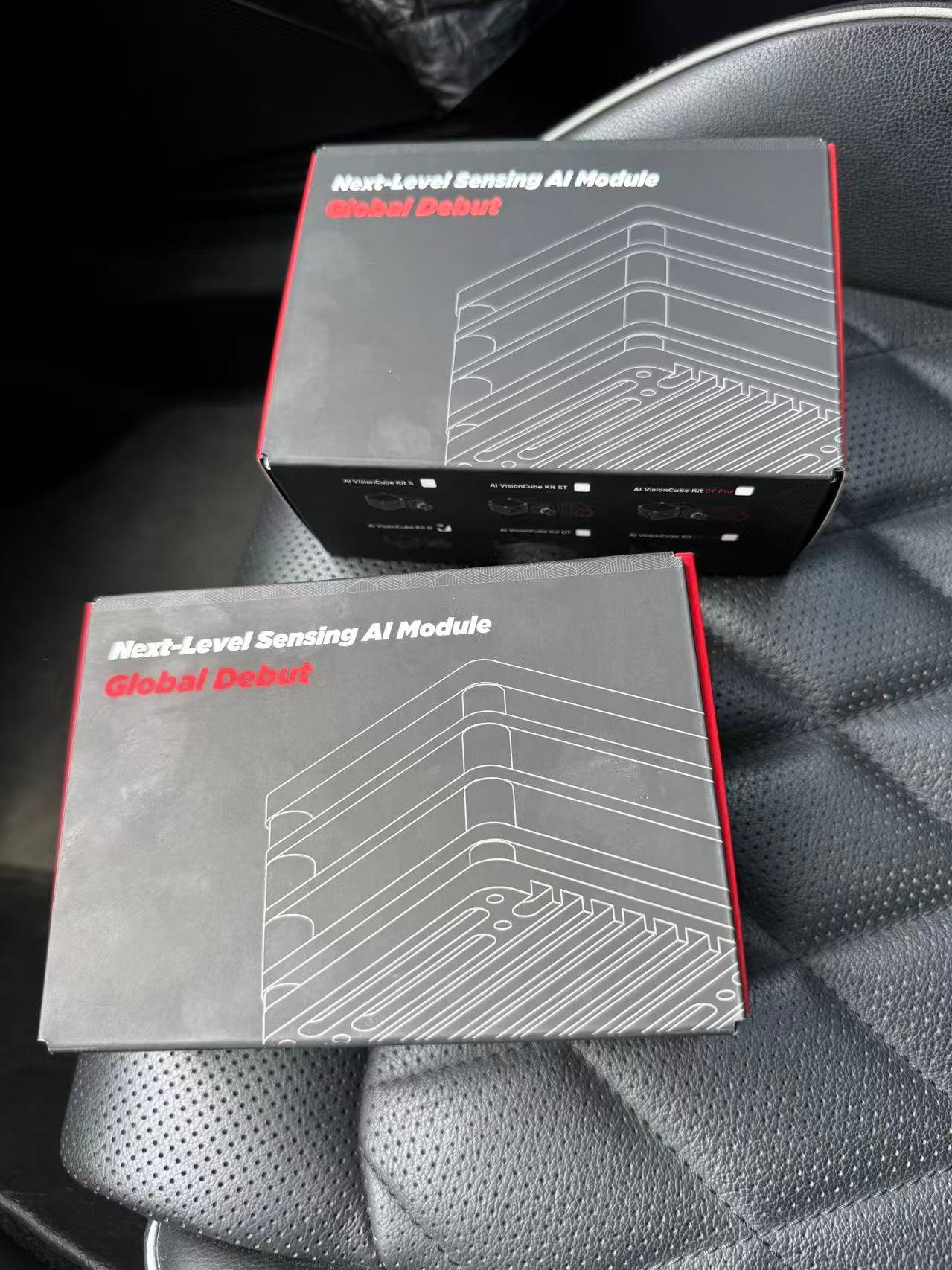
AERVUE supplies six AI Vision Modules covering the 1 TOPS to 6 TOPS spectrum, with sensor pairings that match the operating profile categories above. All modules ship pre-trained for vehicle and person detection, support up to 50 simultaneous tracked targets, output telemetry over CRSF, and run on 9–16V.
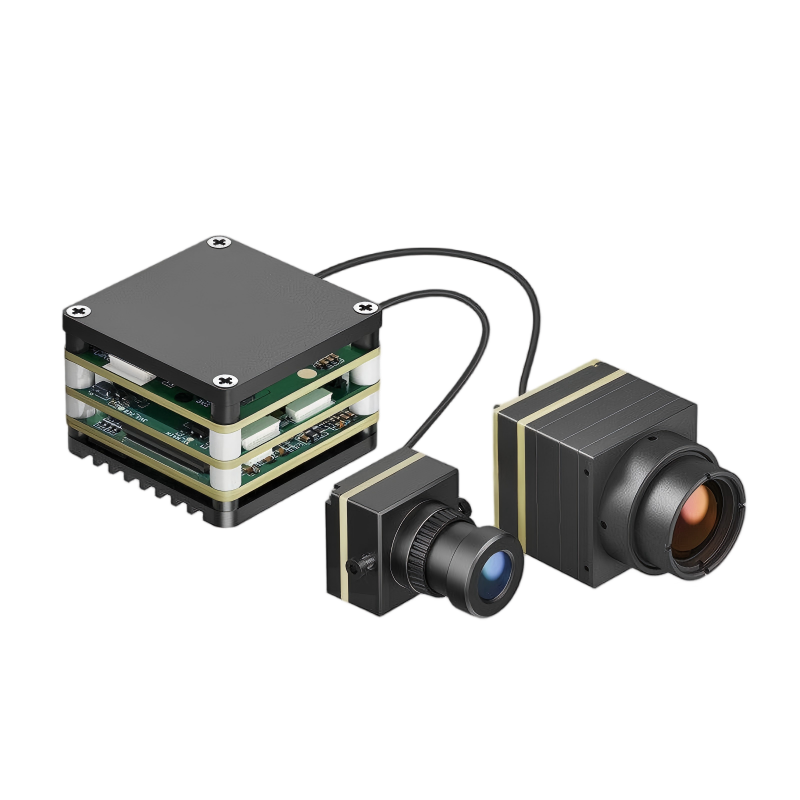
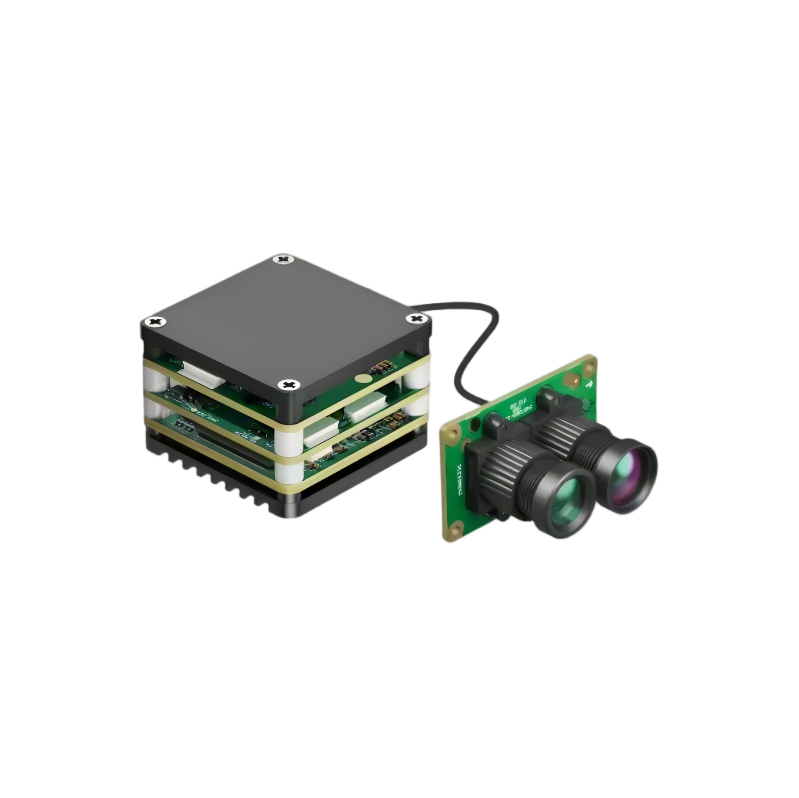
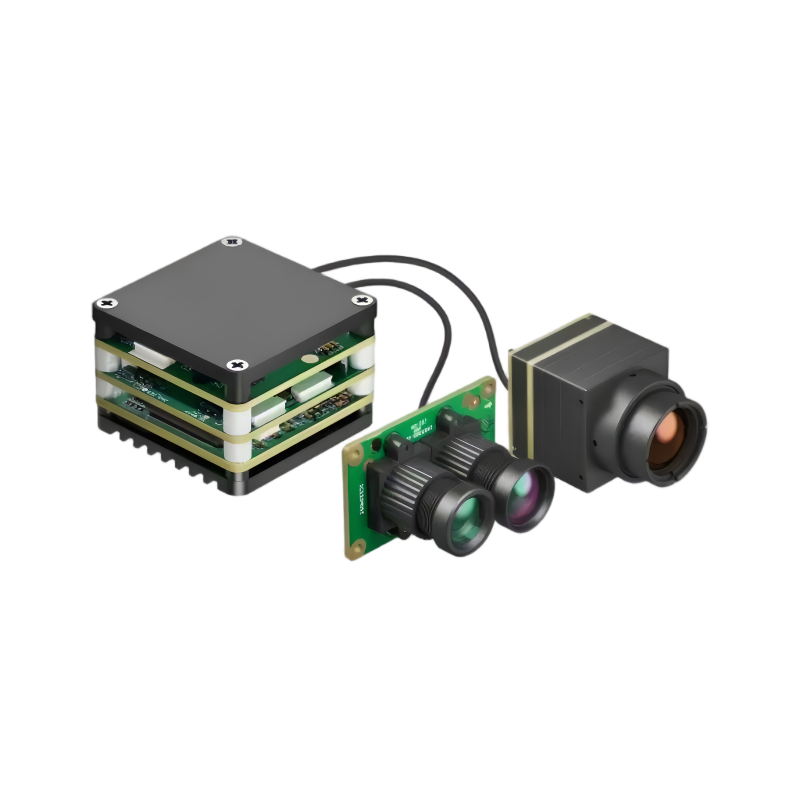
All AERVUE VisionCube modules support OEM customization on housing, branded OSD watermark, and firmware. Custom-trained detection classes (specific vehicle types, vessel categories, drones) are available from MOQ 100. Factory MOQ for off-the-shelf models is 10 units. Sample lead time 1–3 days; production 1–4 weeks.
10. Selection Checklist
Before placing an order on a drone AI tracking module, walk through these eight questions:
- Range. What is the maximum distance at which you need reliable detection? (Determines TOPS tier and sensor configuration.)
- Light conditions. Will your platform operate in low light, total darkness, or smoke? (Determines thermal pairing.)
- Payload budget. How many grams can you allocate to the module? (Determines tier — heavier modules deliver more capability.)
- Flight stack. CRSF, MAVLink, or both? What flight controller? (Determines compatibility — verify before ordering.)
- Volume and BOM target. 10 units, 100, or 1000? (Pricing breaks vary by tier and vendor.)
- OEM requirements. Branding, custom OSD, custom detection classes? (Determines vendor — not all support these.)
- Firmware lifecycle. Will you need OTA updates a year from now? (Locked-firmware vendors are a long-term liability.)
- Export documentation. Are you certifying for markets that require specific compliance documentation? (Determines vendor location and paperwork.)
Conclusion
The drone AI tracking module market in 2026 is no longer dominated by closed proprietary systems with five-figure unit pricing. Modules from Chinese factory-direct suppliers like AERVUE deliver hardware capabilities equal to or better than three-year-old proprietary systems at a fraction of the cost. The 1 TOPS to 6 TOPS spectrum, paired with mono, dual visible, or thermal-hybrid sensors, gives platform builders genuine flexibility across mission profiles.
For OEM platform integrators, the decision usually comes down to three questions: what range, what light conditions, and what payload budget. Answer those three honestly and the right module in the AERVUE VisionCube range tends to be obvious — VisionCube S for cost-optimized daytime, VisionCube D for serious daytime range, DT Pro for the full long-range day-and-night envelope.
If you are integrating an AI tracking module into a commercial drone platform and want a sample to evaluate against your flight stack, our engineering team can help match the right tier to your application before you commit to volume.
Building an AI-tracking drone platform?
Tell us your airframe, mission profile, and detection range requirements. We will recommend the right VisionCube tier and sensor configuration — with factory-direct pricing and sample availability within 1–3 days.