Choosing the right thermal camera for drones starts with understanding resolution, pixel pitch, and NETD — not just the spec sheet headline. This guide covers everything drone operators and OEM manufacturers need to know before buying a thermal camera for professional drone applications .
1. What Is a Thermal Camera for Drones?
A thermal camera detects heat radiation rather than visible light. Every object above absolute zero emits infrared radiation — the hotter the object, the more radiation it emits. A thermal sensor captures these temperature differences and converts them into a viewable image.
On drones, thermal cameras are used as dedicated payloads or integrated camera modules. They operate completely independently of lighting conditions — bright sunlight, total darkness, smoke, or haze do not affect thermal imaging performance.
Key difference: A standard FPV camera captures visible light. A thermal camera captures temperature differences. Most professional drone platforms combine both — an FPV camera for navigation, and a thermal camera for the actual inspection or detection task.
2. Key Specifications Explained
Resolution
Thermal camera resolution is measured in pixels. Common drone thermal resolutions are 256×192, 384×288, and 640×512. Higher resolution means finer detail and longer effective detection range.
Pixel Pitch
Pixel pitch refers to the physical size of each pixel on the sensor, measured in micrometers (μm). Smaller pixel pitch means more pixels packed into a given sensor area. Common values are 12μm and 17μm. The AERVUE Thermal 640CA uses a 12μm pixel pitch.
NETD (Noise Equivalent Temperature Difference)
NETD measures the sensor's sensitivity — the smallest temperature difference it can reliably detect, expressed in millikelvins (mK). Lower NETD means finer temperature discrimination. ≤30mK is considered excellent and is the standard for professional inspection applications.
Spectral Response Band
The most common band for drone applications is the 8–14μm Long-Wave Infrared (LWIR) band.
Frame Rate
For inspection and search applications, 25fps is typically sufficient. This is the practical commercial standard for most drone thermal payloads.
3. Resolution: 256 vs 384 vs 640
256×192 — Entry-Level Detection
The AERVUE Thermal 256 achieves people detection at up to 440 meters and vehicle detection at over 1,000 meters. Best for: Cost-sensitive deployments, short-range inspection, entry-level commercial UAV integration.
384×288 — Mid-Range Performance
The Thermal 384 achieves people detection at 1,100 meters and vehicle detection at 2,574 meters. Best for: Infrastructure inspection, power line surveys, agricultural scouting, medium-altitude commercial UAVs.
640×512 — Professional Grade
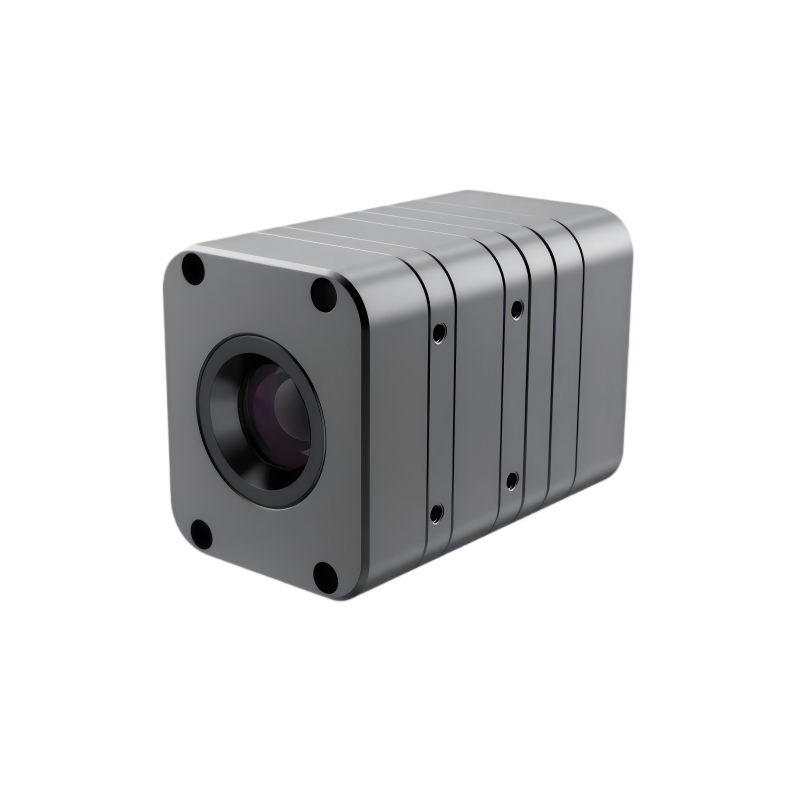
The AERVUE Thermal 640 achieves people detection at 1,200 meters and vehicle detection at 2,650 meters. The Thermal 640CA takes this further with a 12μm ceramic-core sensor and ≤30mK NETD. Best for: Search and rescue, high-altitude inspection, critical infrastructure, OEM integration.
4. Pixel Pitch and NETD — Why They Matter More Than Resolution Alone
Two drones with 640×512 thermal cameras can produce very different image quality depending on pixel pitch and NETD. A sensor with 17μm pixel pitch captures less spatial information per pixel than a 12μm sensor of the same resolution.
Rule of thumb: For the best thermal image quality, prioritize smaller pixel pitch (12μm or less) combined with low NETD (≤30mK). These two specs together determine how well the camera distinguishes fine temperature detail — resolution alone does not tell the full story.
5. Detection Range — Understanding the Numbers
Thermal camera manufacturers publish detection range figures based on the Johnson Criteria — an industry-standard method defining detection, recognition, and identification distances.
- Detection: You can tell something is there (a heat source exists)
- Recognition: You can determine the type of object (person vs. vehicle)
- Identification: You can identify the specific target in detail
Published detection ranges refer to the detection threshold, not identification. In practical deployment, effective recognition range is typically 30–50% of the published detection figure.
6. Use Case Guide
Search and Rescue (SAR)
SAR operations demand long detection range, low NETD, and reliable performance in complete darkness. The Thermal 640 or Thermal 640CA are the correct choice — their people detection capability (1,100–1,200m) lets a drone scan large areas quickly.
Infrastructure and Power Line Inspection
Detecting heat anomalies in electrical equipment, solar panels, and pipelines requires fine temperature discrimination. ≤30mK NETD and 640×512 resolution are recommended. The Thermal 640CA is ideal.
Precision Agriculture
Crop stress, irrigation management, and pest/disease detection can be monitored with the Thermal 384 or Thermal 640. Mid-resolution sensors provide sufficient detail for field-level analysis.
Border and Perimeter Security
Long detection range is the priority. The Thermal 384 and Thermal 640 both provide vehicle detection beyond 2,500m.
7. Thermal vs. FPV Camera — Which Do You Need?
In most professional drone applications, you need both. The FPV camera handles navigation; the thermal camera handles the sensing task.
| Feature | FPV Camera | Thermal Camera |
|---|---|---|
| Light requirement | Requires ambient light | Works in total darkness |
| Image type | Visible light (color / B&W) | Heat map (temperature contrast) |
| Primary use | Navigation, piloting | Detection, inspection, analysis |
| Resolution | 1200–1800TVL analog | 256×192 to 640×512 |
| Works in smoke/fog | No | Partially (LWIR penetrates light fog) |
8. OEM Buying Considerations
- Pixel pitch and NETD — Define the quality ceiling of your product
- Operating temperature range — Thermal 640CA rated -40°C to +60°C
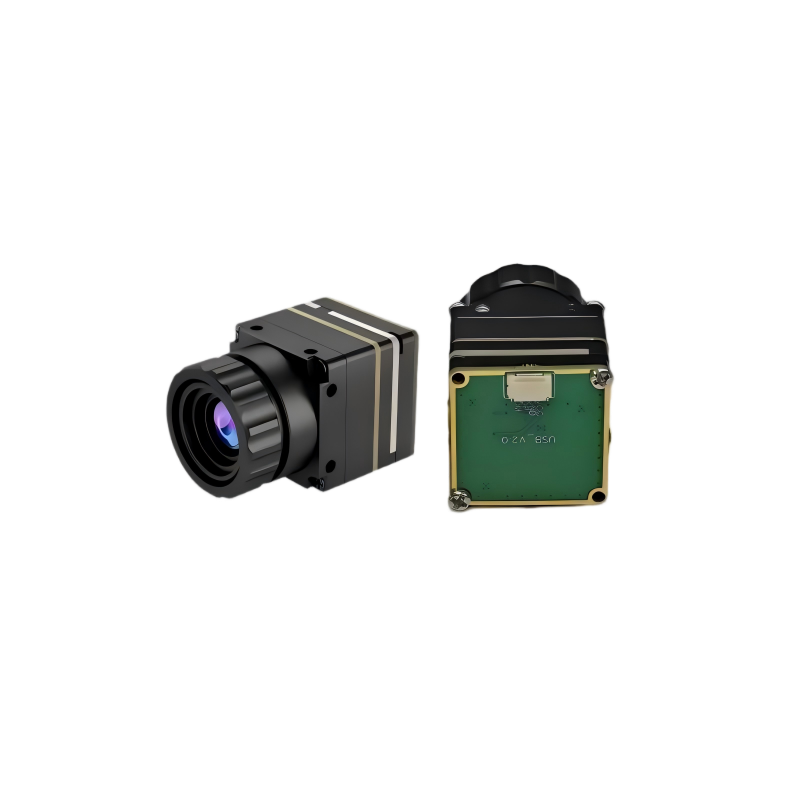
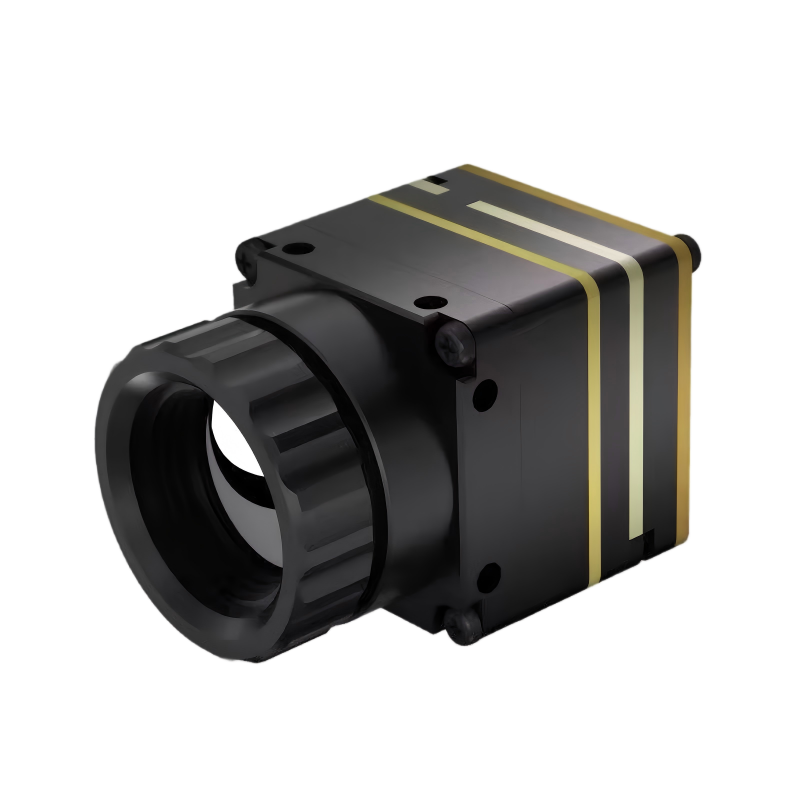
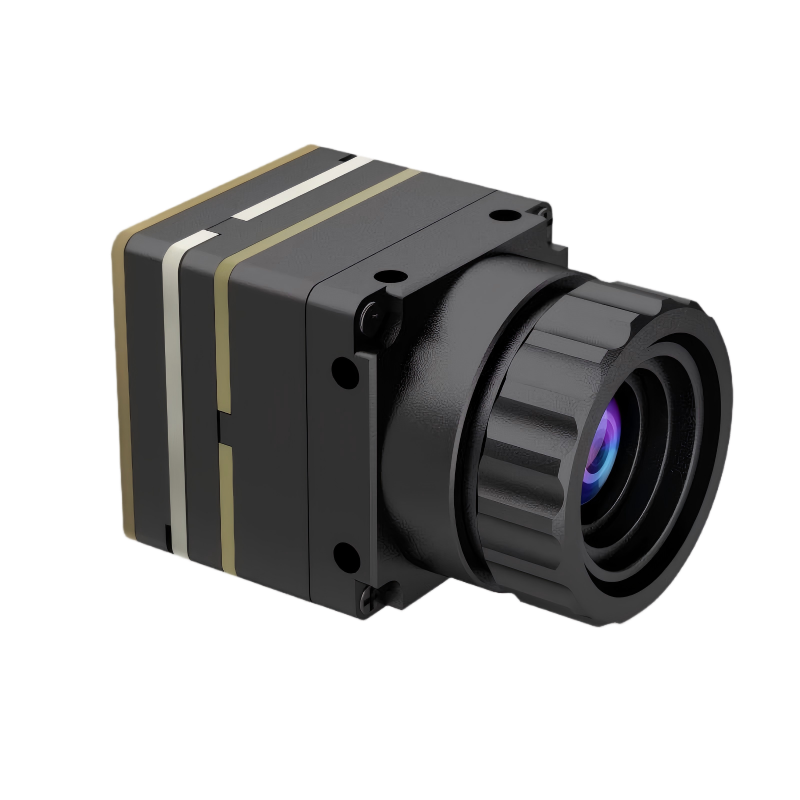
- Size and weight — Thermal 256/384/640 all share a compact 21×21mm footprint at 22g
- CE/FCC certification — Verify for your target markets before volume commitment
- MOQ and samples — AERVUE ships samples within 3–5 business days
- Custom firmware and branding — Available from MOQ 20 units
9. AERVUE Thermal Camera Lineup
| Model | Resolution | People Detection | Vehicle Detection | Size / Weight | Best For |
|---|---|---|---|---|---|
| Thermal 256 | 256×192 | 440m | 1,051m | 21×21mm · 22g | Entry / Cost-sensitive |
| Thermal 384 | 384×288 | 1,100m | 2,574m | 21×21mm · 22g | Inspection / Agriculture |
| Thermal 640 | 640×512 | 1,200m | 2,650m | 21×21mm · 22g | SAR / Security |
| Thermal 640CA | 640×512 · 12μm | — | — | 27×32×45mm | Pro OEM / Critical Inspection |
10. Final Checklist Before You Buy
- ✅ Resolution matches your detection range requirement (256 / 384 / 640)
- ✅ Pixel pitch is 12–17μm — smaller is better for image detail
- ✅ NETD is ≤30mK for professional inspection applications
- ✅ Spectral response is 8–14μm LWIR for ambient temperature detection
- ✅ Size and weight are compatible with your drone payload system
- ✅ Operating temperature range covers your deployment environment
- ✅ CE/FCC certification confirmed for your target markets
- ✅ Supplier supports OEM branding and custom firmware if needed
- ✅ Sample units available before volume commitment
Conclusion
Choosing the right thermal camera for your drone comes down to matching the sensor's capabilities to your actual application. For cost-sensitive entry-level deployments, the Thermal 256 delivers reliable detection at range. For the majority of professional inspection and surveillance applications, the Thermal 384 offers the best balance. For demanding SAR, security, and critical infrastructure work, the Thermal 640 or Thermal 640CA are the clear choice.
AERVUE's thermal camera modules offer factory-direct pricing with OEM customization support from MOQ 20 units — backed by a team that responds to every inquiry within 24 hours.
Ready to source thermal cameras?
Factory-direct supply · OEM support from MOQ 20 units · Reply within 24 hours.